ville
Madaba
A small Christian town that sleeps the oldest cartographic map of Jerusalem in the world — a 6th-century Byzantine mosaic, worth seeing once in a lifetime.
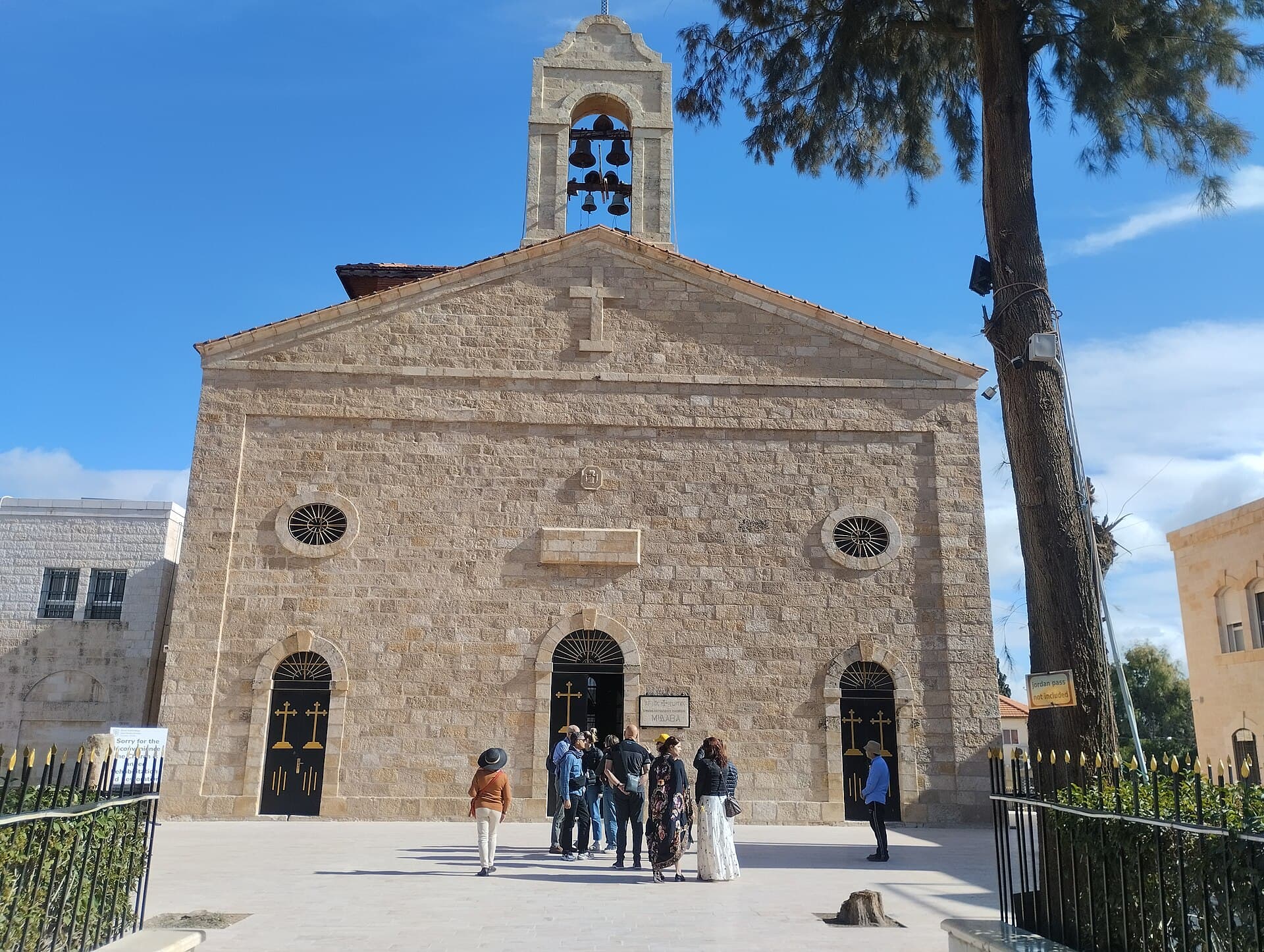
Madaba is one of Jordan's most singular destinations: a small town of 70,000 inhabitants, 30 kilometres south-west of Amman on the plateau overlooking the Jordan Valley, whose identity is deeply Christian — a rarity in the Middle East — and whose worldwide fame rests on an exceptional Byzantine artwork. In the nave of the Greek Orthodox Church of Saint George, rebuilt in 1896, sleeps a 6th-century floor mosaic that depicts the Holy Land with a degree of topographic precision unmatched for its time — it is the oldest known cartographic map of Jerusalem in the world. Accidentally discovered during the new church excavations, restored by Italian archaeologists in the 1960s, it remains in situ, at the feet of the faithful: going to Madaba means walking around this fourteen-century-old map that shows Jerusalem, the Holy Sepulchre, the Jordan, the Dead Sea, the Nile delta and more than a hundred holy sites identified with stunning accuracy.
But Madaba is not just a town with a mosaic. Nicknamed the town of mosaics, it preserves several other exceptional Byzantine works: the Hippolytus Mosaic at the Archaeological Park (high-quality mythological scenes), the Church of the Apostles mosaics (animals and personifications of Thalassa, the sea) and several others in the Regional Archaeological Museum. The town also hosts the Madaba Institute for Mosaic Art and Restoration, a unique school in the Middle East perpetuating this ancestral art. Just 10 kilometres away, Mount Nebo — the summit from which Moses is said to have contemplated the Promised Land according to biblical tradition before dying — offers one of the most moving panoramas in the Levant: on a clear day, you can see Jerusalem, Bethlehem, the Mount of Olives and the Dead Sea shimmering 1,200 metres below. Madaba is best visited as a full-day trip from Amman, combined with Mount Nebo and a float in the Dead Sea — a triptych among the finest cultural and spiritual itineraries in the Middle East.
What we love
- ✅Oldest cartographic map of Jerusalem in the world (6th century), in situ in St George's Church
- ✅Historic Christian town in the Levant — a rare encounter with a living Arab Christian community
- ✅Nearby Mount Nebo (10 km): exceptional biblical panorama over the Promised Land
- ✅Accessible as a day trip from Amman (30-minute drive)
- ✅Calm and authentic: an atmosphere opposite to Petra or Wadi Rum, ideal as a complement
What to know
- ❌Short visit: 2-3 hours on site is enough, not a destination in itself
- ❌Map mosaic hard to photograph (controlled lighting, crowds in the nave)
- ❌Mount Nebo as a distant panorama: more suggestive than obvious, only on clear days
- ❌Limited local accommodation, most visitors come on a day trip from Amman
Situation
Où se situe Madaba ?
Ouvrir la carte en grand sur OpenStreetMap →Frequently asked questions
Why is the Madaba map mosaic so important?+
How long do I need in Madaba?+
How do I get to Madaba from Amman?+
Should I visit Mount Nebo after Madaba?+
Does the Jordan Pass cover Madaba?+
What should I taste in Madaba?+
Is Madaba a safe stop for travellers?+
Is there value in sleeping in Madaba rather than Amman?+
Our verdict
Madaba is probably the most singular Jordanian destination: a small Christian town in the heart of a Muslim country, watching for fourteen centuries over the world's oldest map of Jerusalem. Our advice: don't dedicate a full day to Madaba alone — it is best experienced combined with Mount Nebo (10 km, biblical panorama over the Promised Land) and the Dead Sea (45 km, legendary floating swim) in a single day trip from Amman. Plan 2 to 3 hours on site: visit Saint George's Church and its map mosaic, lunch with Christian Arab mezze in one of the family restaurants downtown, then Mount Nebo in mid-afternoon for sunset over the Jordan Valley.
Nearby

"Frais (10°C), tarifs bas, Wadi Rum glacial."
Expert on Madaba · 1 contributions
 Mediterranean Desk — Mowando·Editor