ville
Sapporo
Asia's most spectacular snow festival, a world-conquering miso ramen and Niseko's world-class powder just two hours away — Sapporo is a northern city unlike any other.
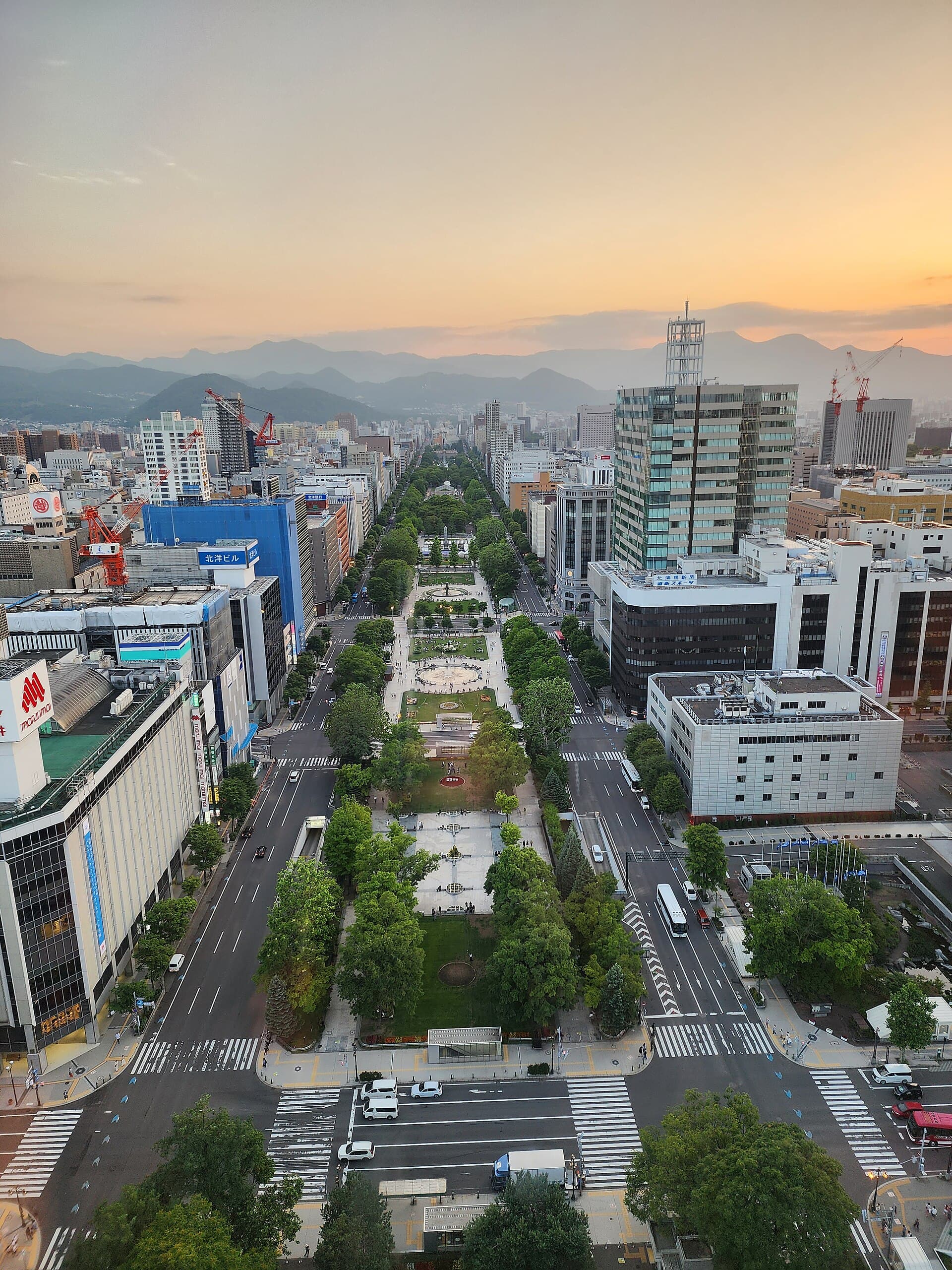
Sapporo is Japan's great northern city — the capital of Hokkaido, the country's fifth-largest city and the gateway to the archipelago's wildest island. Founded only in 1868 during the Meiji-era colonisation of Hokkaido, it is one of the few Japanese cities built on an American-style grid plan, which gives it a legibility rare in the archipelago. Its wide avenues, generous parks and half-Nordic, half-Japanese architecture lend it a visual identity very distinct from Tokyo or Osaka.
Sapporo is world-famous for its Yuki Matsuri (Snow Festival), held each year in early February: for one week, monumental snow and ice sculptures — some several storeys tall — fill Odori Park and the Susukino district in an illuminated nocturnal spectacle that draws more than two million visitors. It is one of the world's largest winter events and one of the most memorable experiences available anywhere in Japan.
But Sapporo is also a serious food city. Miso ramen — now popular across Japan and around the world — was invented here in the 1960s: the rich, complex, umami-loaded broth that characterises this style of ramen is a speciality best appreciated in Sapporo itself. The Sapporo Brewery, founded in 1876 and Japan's oldest major brewery, houses a museum and tasting hall in its original red-brick factory building — an unmissable stop. Nijo Market, a short walk from the centre, overflows with Hokkaido produce: sea urchin (uni) of incomparable freshness, king crab, giant scallops, salmon — the best address for discovering the island's maritime riches.
In the evening, the Susukino district — one of Japan's largest entertainment quarters after Kabukicho in Tokyo — deploys its neon signs, izakaya, whisky bars and seafood restaurants in a warmth that the cold outside makes all the more welcoming. And just 30 minutes by JR, the small city of Otaru completes a perfect day trip: its romantic canal lined with converted stone warehouses turned restaurants and hand-blown glass shops is one of the finest urban scenes in Hokkaido.
What we love
- ✅Yuki Matsuri (Snow Festival) in early February: one of the world's most spectacular winter events
- ✅Miso ramen invented here — tasting it in a real Sapporo ramen shop is an unmatched experience
- ✅Exceptional Hokkaido seafood (sea urchin, crab, scallops) at prices below the rest of Japan
- ✅Niseko (2h by road) for the world's best powder snow, accessible as a day or overnight trip from the city
- ✅Legible grid-plan city, pleasant to explore on foot in any season — with heated underground galleries for winter
What to know
- ❌Very cold and snowy winters (temperatures between -10 and -2 °C from December to March)
- ❌Less historical heritage and temples than Kyoto or Nara — interest is primarily gastronomic and nature-based
- ❌Far from the rest of Japan: 1h30 flight from Tokyo, requiring an additional ticket outside the standard JR Pass
Situation
Où se situe Sapporo ?
Ouvrir la carte en grand sur OpenStreetMap →Frequently asked questions
How many days should I plan for Sapporo?+
Where should I eat the best miso ramen in Sapporo?+
What is the Yuki Matsuri and how should I prepare for it?+
Can you ski from Sapporo as a base?+
How do you get to Sapporo from Tokyo?+
What are the best markets and addresses for seafood in Sapporo?+
What is Sapporo's underground network?+
Our verdict
Sapporo is an atypical city in the Japanese landscape: modern, laid out on a North American grid, more Nordic than Asian in its winter landscapes, and yet deeply Japanese in its gastronomy and hospitality. It offers the best starting point for exploring Hokkaido in any season, with a city centre rich enough to deserve two to three days before heading out to Niseko, Furano or Shiretoko. Come in February for the Yuki Matsuri, in July for the beer festival and the lavender, or in September for the momiji and the crab — each season has its festival.
Réserver votre séjour
Liens partenaires — une commission peut nous être reversée, sans surcoût pour vous.
 HébergementAnnulation gratuite
Hôtels & ryokans au Japon
Business hotels efficaces dans les grandes villes, ryokans avec onsen privatif, capsules à Tokyo : tout le Japon comparé sans surprise.
ActivitéSans queueActivités au Japon
Cérémonies du thé à Kyoto, JR Pass, Mont Fuji, sumo, cours de sushi : réservez les activités phares sans queue.
VolComparateurVols vers Tokyo
Comparez Paris-Tokyo, Paris-Osaka et les vols low-cost intra-Japon. Saison épaule oct-nov souvent 30 % moins chère.
Nearby

"Janvier est le cœur de l'hiver à Sapporo — neige quasi quotidienne, températures froides mais ville parfaitement déneigée. Les skieurs affluent vers Niseko et les stations proches. L'atmosphère est feutrée, les izakaya de Susukino sont particulièrement accueillants sous la neige."
Expert on Sapporo · 1 contributions
 Japan Desk — Mowando·Editor