ville
Jaipur
Rajasthan capital and Golden Triangle's 3rd summit — "pink city" since 1876 (painted terracotta for Prince of Wales), 2 major UNESCO sites (Amber Fort and Jantar Mantar), Maharaja Jai Singh II palaces.
Jaipur (3.1 million inhabitants) is the capital of Rajasthan and the 3rd classic stop of the Golden Triangle after Delhi and Agra. Founded in 1727 by Maharaja Sawai Jai Singh II (1688-1743, amateur astronomer and visionary strategist who transferred his capital from Amber 11 km further north), the city was India's first example of planned urbanism — geometric grid of 9 squares (chowkris) inspired by Hindu Vastu Shastra, perfectly orthogonal wide avenues, monumental gates at 4 cardinal points. This rigorous planning makes Jaipur an exception in historical Indian urbanism and earned it UNESCO listing 2019.
Jaipur is nicknamed the "pink city" since 1876, when Maharaja Ram Singh II ordered the entire old town to be painted terracotta to welcome visiting Prince of Wales Edward VII. This tradition continues today: all buildings of the old town inside the ramparts must be painted pink-orange. It's one of India's most photogenic cities.
The must-see sites. At the old town's heart, City Palace (1727-1734, official residence of the royal Kachwaha family still occupying a private part today — current Maharaja Padmanabh Singh). Next to it, Hawa Mahal (1799, "Palace of Winds", 5-story palace in pink sandstone built by Sawai Pratap Singh to allow royal harem women to observe street processions without being seen — 953 jali windows). Next to it, Jantar Mantar (UNESCO 2010), 18th-century astronomical observatory built by Jai Singh II, 19 giant marble instruments including Samrat Yantra — the world's largest sundial (27 m high, theoretical 2-second precision).
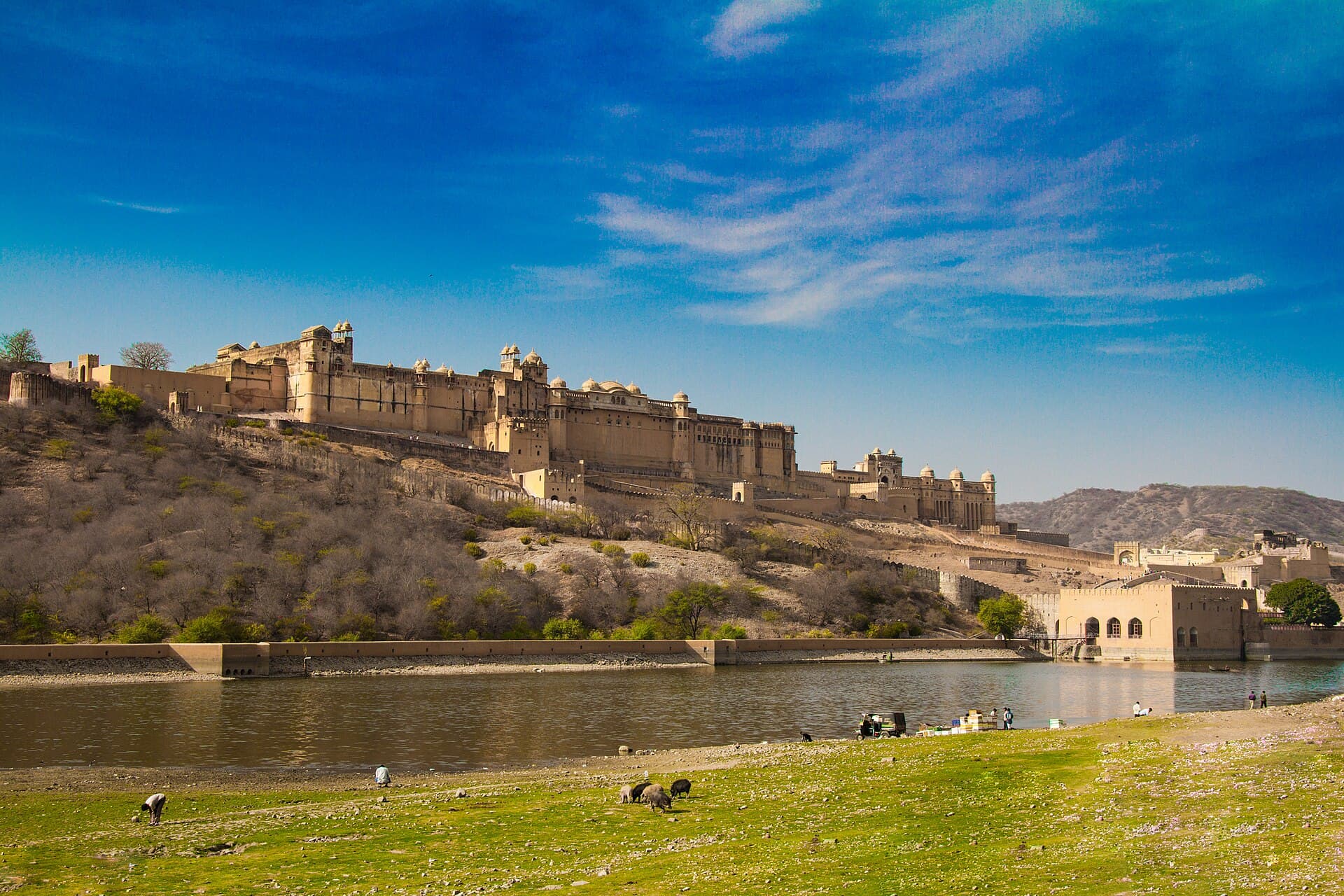
11 km north of Jaipur, Amber Fort (UNESCO 2013) is the half-day major stop. Palace-fort in yellow sandstone and white marble built from 1592 by Maharaja Man Singh I. Inside: Sheesh Mahal ("Palace of Mirrors"), Diwan-i-Aam, Sukh Niwas. Access by jeep 4x4 (200-400 INR), on foot (15-20 min), or by elephant (ethically controversial).
What we love
- ✅2 UNESCO sites: Amber Fort (2013, Hill Forts of Rajasthan) and Jantar Mantar (2010, astronomical observatory with world's largest sundial) + Jaipur Walled City (UNESCO 2019)
- ✅Uniquely photogenic Hawa Mahal: 953 jali windows in pink sandstone, iconic facade
- ✅City Palace still Maharaja Padmanabh Singh's residence — living heritage
- ✅Exceptional artisan shopping: Johari Bazaar (jewellery), Bapu Bazaar (textiles), Anokhi boutiques, painted miniatures
- ✅Jaipur Literature Festival (mid-January) — the world's largest free literary festival
What to know
- ❌Extreme crowds in high season at Hawa Mahal and Amber Fort (opening arrival recommended)
- ❌Notable air pollution but less than Delhi (AQI 100-200 winter)
- ❌Frequent tourist scams: fake guides, fake gem merchants
- ❌Significant distances between sites (Amber Fort 11 km north, Nahargarh 6 km)
- ❌Amber Fort elephant ride ethically controversial
Situation
Où se situe Jaipur ?
Ouvrir la carte en grand sur OpenStreetMap →Frequently asked questions
How many nights in Jaipur?+
How to get to Jaipur from Delhi or Agra?+
Should I ride an elephant up to Amber Fort?+
Where to stay in Jaipur for a romantic experience?+
Our verdict
Jaipur is the most complete summit of the Golden Triangle and probably the most appreciated stop by travellers. The pink city offers exceptional heritage density (2 UNESCO sites + listed city), unique photographic iconicity (Hawa Mahal, Amber Fort, Jal Mahal), living heritage (City Palace still occupied by Kachwahas) and legendary artisan shopping. Our advice: 2-3 nights minimum. Itinerary: D1 City Palace + Hawa Mahal + Jantar Mantar (old town by foot or tuk-tuk), D2 half-day Amber Fort + Nahargarh Fort (panoramic sunset) + Jal Mahal photo + bazaars, D3 (optional) Galtaji Monkey Temple + Jaigarh Fort + bazaar shopping + Rajasthani cooking class. Ideal period: November-March (but avoid mid-January for Lit Fest crowds). Iconic hotels: Rambagh Palace (Taj, former Maharaja palace 1835-1925, €500-1,200/night, absolute icon), Suján Rajmahal Palace (€350-700/night), Oberoi Rajvilas (€600-1,200/night), ITC Rajputana (€200-400/night), Samode Haveli (€150-300/night). Recommended arrival by car from Agra via Fatehpur Sikri (4h, 7,000-10,000 INR with driver).
Nearby

"Janvier : haute saison, Jaipur Literature Festival mi-janvier, climat parfait."
Expert on Jaipur · 1 contributions
 South-East Asia Desk — Mowando·Editor