site naturel
Gullfoss
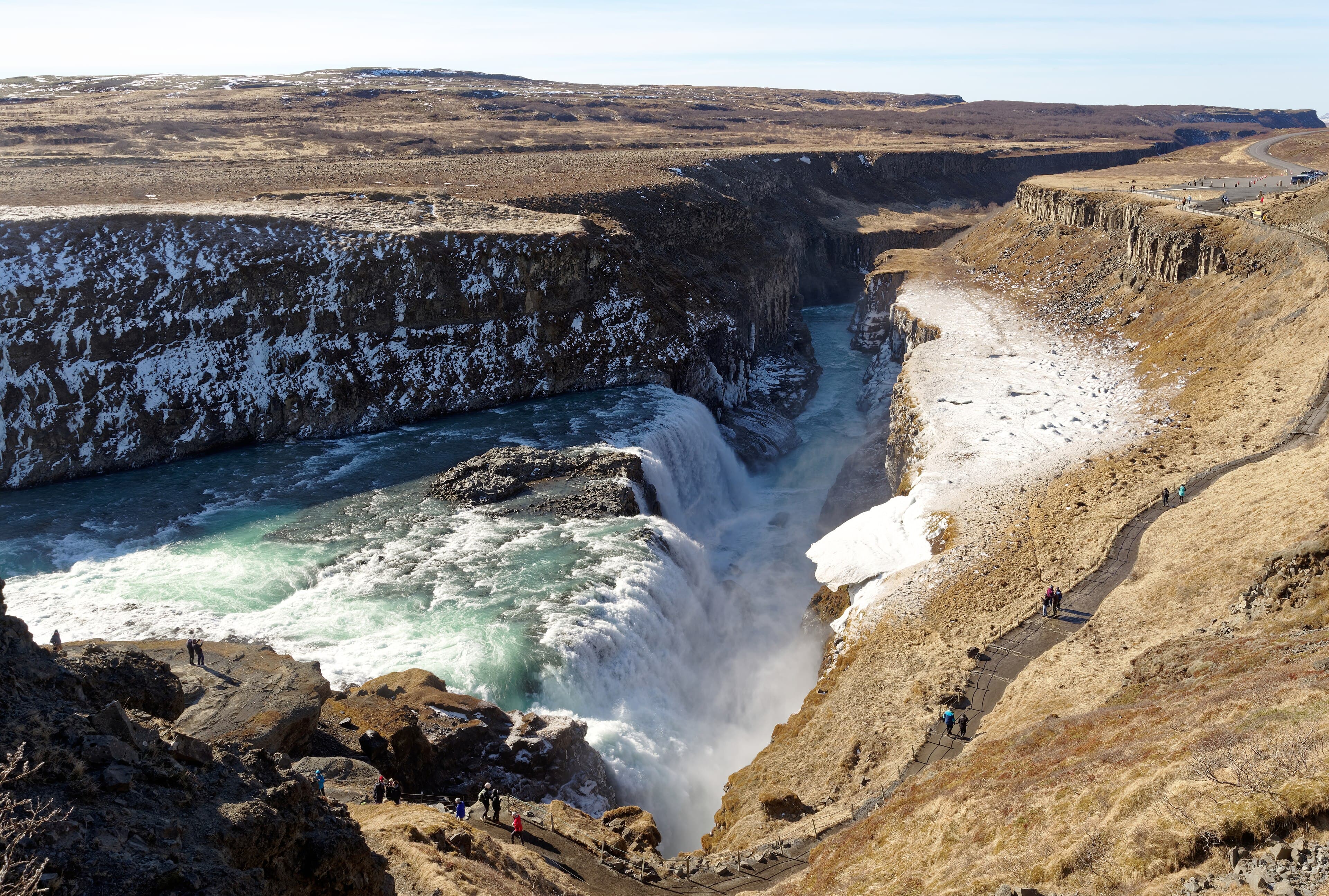
Iceland's most impressive hydraulic spectacle: 140 m³/second on average, two drops of 11 m then 21 m in a 70 m deep canyon, free access year-round.
Gullfoss ('golden waterfall') is one of the most emblematic waterfalls in Iceland and Europe. Located 10 km north-east of Geysir, at the eastern end of the Golden Circle, it is fed by the Hvítá ('white river'), which descends from the Langjökull glacier (Iceland's second-largest). The average flow is 140 m³/second, with peaks of 2,000 m³/s in spring flood — one of Europe's most powerful waterfalls by volume.
The waterfall presents itself in two successive drops: a first of 11 m, then a second of 21 m, totalling 32 m of elevation. What makes Gullfoss unique is the angle of the two drops: they are not aligned but perpendicular to each other, creating a right-angle staircase shape that plunges into a 70 m deep basalt canyon. The canyon, cut by the river into the Tertiary basalt bedrock, can only be seen from the upper viewpoint — from the lower viewpoint, you see the waterfall head-on.
On sunny days, the spray creates near-permanent rainbows above the waterfall — a visual spectacle that has contributed to Gullfoss's global fame. The expression 'golden waterfall' may come either from the golden colour the spray takes at sunset, or from a legend in which a farmer threw his gold coins into the waterfall rather than give them to a usurper.
The history of Gullfoss is also remarkable. In the early 20th century (1907-1929), the site was nearly destroyed by the construction of a hydroelectric dam: a British investor had obtained the rights from the neighbouring farmer Tómas Tómasson. It was the farmer's daughter, Sigríður Tómasdóttir, who led a 20-year legal battle to save the waterfall. She walked on foot (in birch-bark sandals) the 120 km between Gullfoss and Reykjavik several times to bring her arguments before the court, and threatened to throw herself into the waterfall if the dam were built. The project was finally abandoned in 1929 (the contract was not honoured for default of payment), and Gullfoss was permanently protected as a natural monument in 1979. A commemorative plaque at the upper viewpoint honours her fight. Sigríður Tómasdóttir is today considered Iceland's first environmental activist and one of the great female figures of the country's history.
What we love
- ✅Exceptional hydraulic spectacle: 140 m³/s on average, two tiers totalling 32 m drop
- ✅Free access year-round (parking and trails)
- ✅Two complementary viewpoints: upper (panoramic view on both tiers) and lower (head-on view)
- ✅Near-permanent rainbows on sunny days
- ✅Moving history of Sigríður Tómasdóttir, Iceland's first environmental activist
What to know
- ❌Heavy crowds between 10am and 4pm in high season (tour buses)
- ❌Lower trail sometimes closed in winter (ice, frost)
- ❌No on-site accommodation (Hotel Gullfoss 5 min, Hotel Geysir 10 min)
- ❌Average and expensive car-park cafeteria (€15-25/person)
Situation
Où se situe Gullfoss ?
Ouvrir la carte en grand sur OpenStreetMap →Frequently asked questions
How long to spend at Gullfoss?+
Do you need a waterproof for Gullfoss?+
Is Gullfoss accessible in winter?+
What is Sigríður Tómasdóttir's legend?+
Is there a restaurant at Gullfoss?+
Can you combine Gullfoss with other sites in one day?+
Our verdict
Gullfoss is one of Europe's most impressive waterfalls and an absolute must-do of the Golden Circle. Count 30-60 minutes on site for the two viewpoints (upper for panoramic view, lower for immersive experience with spray). Our tip: arrive before 10am or after 5pm to avoid the tour-bus crowds, bring a waterproof for the lower viewpoint (heavy spray), and don't miss the commemorative plaque dedicated to Sigríður Tómasdóttir at the upper viewpoint. In winter, the partially frozen waterfall offers a radically different and equally spectacular show — just check the lower trail opening on road.is before leaving.
Nearby

"Aurores boréales, peu de monde."
Expert on Gullfoss · 1 contributions
 Mediterranean Desk — Mowando·Editor