Egilsstaðir (logistics capital) is visited in a few hours. The Lagarfljót lake (10 minutes by car) is one of Iceland's longest lakes (53 km) and according to legend houses a monster comparable to Loch Ness — a 2012 official video shows a mysterious creature at the surface. The Hallormsstaðaskógur forest offers several marked hiking trails, including a 5 km loop around an arboretum of global species planted in the 20th century. The Hengifoss waterfall (3rd tallest in Iceland at 128 m, accessible by a 5 km return hike with 270 m elevation gain) is the region's must-do.
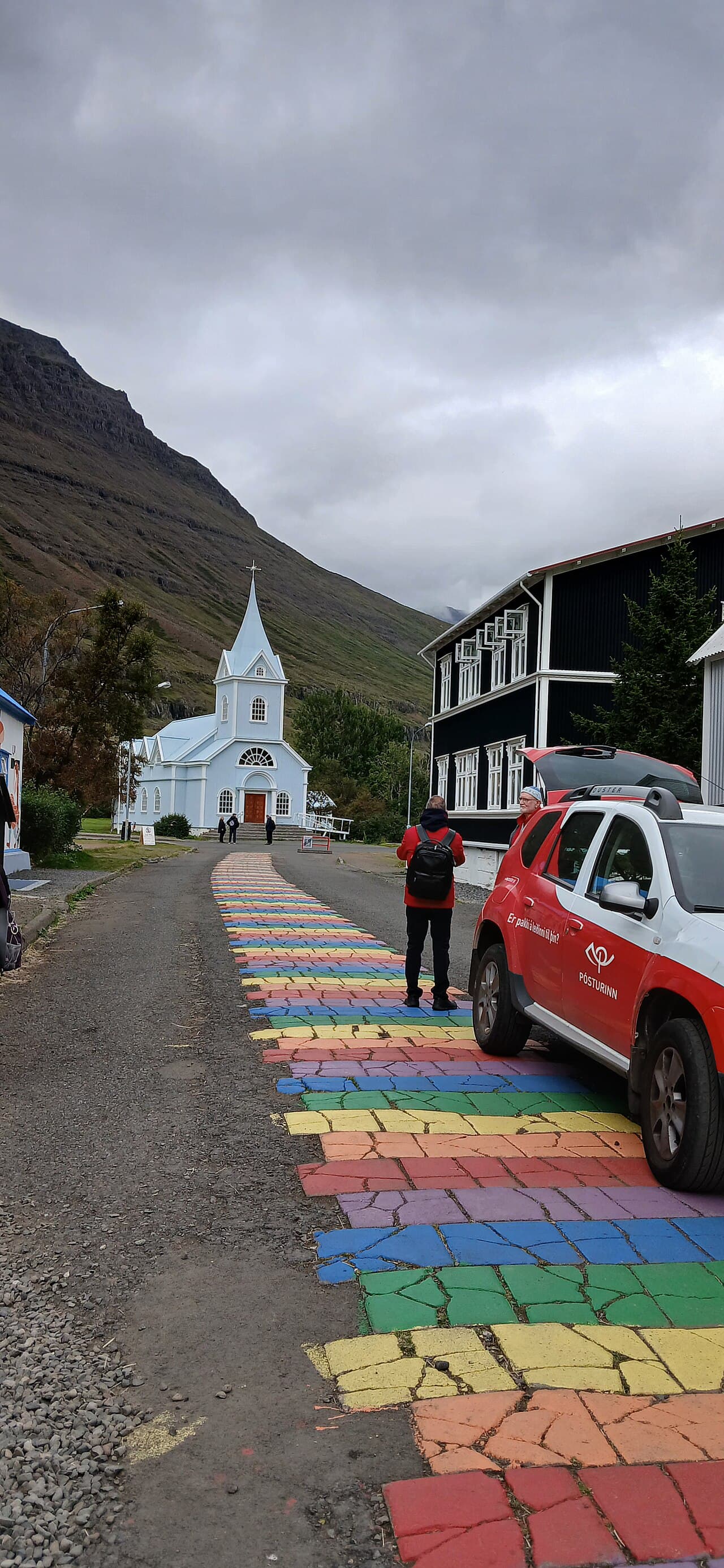
Seyðisfjörður (30 min from Egilsstaðir via Route 93, snowy 620 m pass) is the region's favourite. The village is walked in 2-3 hours: Bláa Kirkjan blue church (1922, neo-classical) at the end of the rainbow street paved in 2017, port and Smyril Line ferry terminal, art galleries (Skaftfell Centre for Visual Art), couturier and jeweller workshops, gastronomic restaurant Norð Austur (surprisingly excellent sushi-omakase in this remote village). The Lunga Festival of alternative art and music (mid-July) draws 1,500-2,000 people for a week — mandatory hotel booking 6 months in advance.
Stuðlagil canyon (1 h north of Egilsstaðir via Route 923) is one of Iceland's most photogenic sites since its 2017 discovery (the hydroelectric dam lowered the level of the Jökulsá á Brú river revealing the canyon). Two accesses: east car park (5 km return walk to reach the iconic viewpoint, easy trail) or west car park (less spectacular view but direct access). Glacial blue-green colour of the river, perfectly regular hexagonal basalt columns — unmissable site for photographers.
The Borgarfjörður Eystri peninsula (Route 94, accessible mid-June to September, closed in winter) hosts one of Iceland's largest puffin colonies. The port of Bakkagerði (100-inhabitant village at the end of the peninsula) offers an observation platform 1-2 metres from puffins (mid-June to mid-August, 4pm-10pm for best observations). The Víknaslóðir trail (deserted bays trails) offers multi-day hikes in preserved valleys, with traditional shelters.
The fjord villages between Höfn and Egilsstaðir each deserve a quick stop. Djúpivogur: Eggin í Gleðivík workshop (34 granite and marble eggs each representing an Icelandic bird), good Vid Voginn restaurant. Stöðvarfjörður: Petra's Stones museum (private collection of Icelandic minerals, ISK 1,500 / €10). Fáskrúðsfjörður: French sailors' cemetery (historical link with Breton and Norman cod fishing in the 19th century, bilingual French/Icelandic panels), French-Icelandic museum. Reyðarfjörður: 1940-1945 British occupation museum (Iceland was occupied by the Allies during WWII to prevent a German occupation).
Read also
- The North and Akureyri — Akureyri, Mývatn, Goðafoss and Húsavík whales: the logical Ring Road continuation north.
- The South Coast — Waterfalls, black beaches and Jökulsárlón glacial lagoon: the previous Ring Road stretch.
- Iceland — Complete country guide: Schengen entry, budget, when to go, regions.
- Reykjavik and the Southwest — The capital, the Blue Lagoon and the Reykjanes peninsula: the Ring Road launchpad.