parc national
Þingvellir
The only place in the world where you can walk in the geological fissure between two continents and photograph a nation's birthplace: Þingvellir combines spectacular geology and founding Viking history.
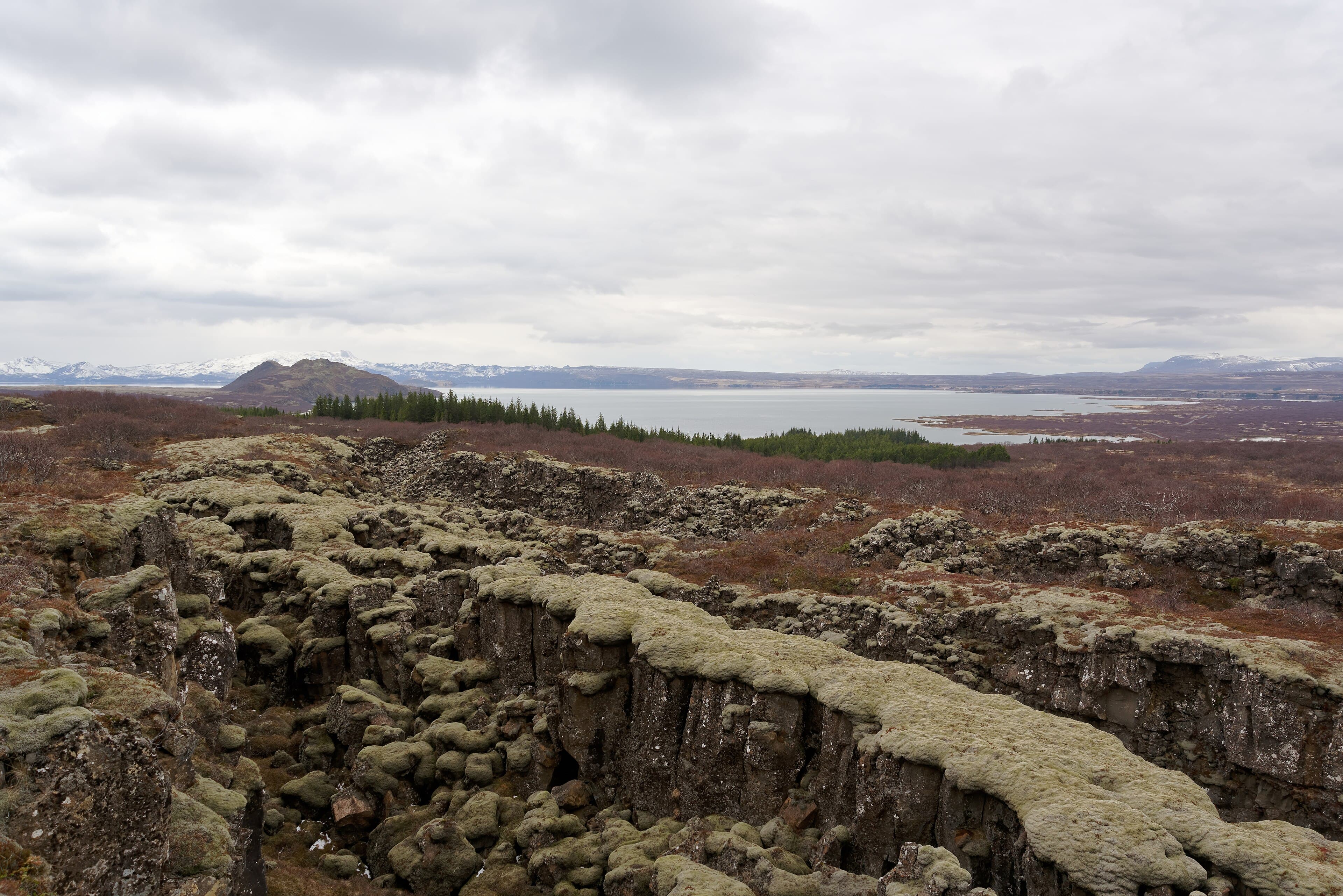
Þingvellir (pronounced 'Thing-vetlir') is probably the most significant site in all of Iceland. It straddles two exceptional dimensions: geological (it is one of the few places in the world where the Mid-Atlantic Ridge emerges above sea level, creating a visible fissure between the Eurasian and North American tectonic plates) and historical (it is here that the Alþingi was founded in 930, considered the world's oldest still-active parliament).
The national park, UNESCO World Heritage-listed in 2004, covers 240 km² at the heart of the Golden Circle, 45 minutes by car east of Reykjavik. The flagship site is the Almannagjá fissure — a rocky valley 8 m deep formed by the separation of tectonic plates (2 cm per year for 10,000 years). You can literally walk in this geological fissure on a 1 km marked path, with the wall of the North American plate on one side, and in the distance (at the edge of Lake Þingvallavatn) the Eurasian plate — a unique sensation of walking between two continents.
It is in this fissure that the Alþingi, the annual assembly of Viking chieftains of Iceland, first met in 930. For two weeks every summer, until 1798, the lawspeaker (Lögsögumaður) recited all Icelandic laws aloud from the Lögberg ('Law Rock'), and free men settled disputes, voted on laws and conducted diplomacy. It is also at Þingvellir that Iceland peacefully adopted Christianity in the year 1000 (through a famous political compromise: the pagan chieftain Þorgeir Ljósvetningagoði spent a night under a beast skin meditating, then declared the adoption of Christianity to preserve the country's unity), and that the modern Republic of Iceland was proclaimed on 17 June 1944, ending 700 years of Norwegian then Danish rule.
Beyond history, Þingvellir hosts an exceptional dive site: the Silfra fissure, submerged in Lake Þingvallavatn. It is one of the only places in the world where you can dive or snorkel between two continental tectonic plates. The water, from the melt of the Langjökull glacier filtered for 30 years through basalt rocks, has exceptional visibility (>100 m) and a constant temperature of 2-4 °C year-round. Tours (€130-180, mandatory professional supervision with Dive.is or Arctic Adventures) last 2 hours with drysuit provided.
Lake Þingvallavatn (84 km², 114 m maximum depth, Iceland's largest natural lake) covers the entire southern part of the park and hosts unique populations of Arctic char, including the lake's endemic subspecies (Salvelinus alpinus thingvallensis) which displays four different morphs — a unique case of rapid evolution studied by biologists.
What we love
- ✅Unique UNESCO site: Mid-Atlantic Ridge geology + founding Viking history
- ✅Free park access, only parking is paid (P1: €6.50)
- ✅Snorkelling/diving at Silfra: world-unique experience between 2 continents
- ✅Easy marked paths (1-3 km), accessible to all levels
- ✅45 min from Reykjavik: easy as half-day or combined Golden Circle day trip
What to know
- ❌Heavy crowds at P1 car park in mid-day (10am-4pm) in high season
- ❌No accommodation directly in the park (Hotel Borealis closest, 15 min)
- ❌Limited and expensive restaurants on site (visitor centre cafeteria)
- ❌Silfra booking mandatory 2-4 weeks ahead in high season
Situation
Où se situe Þingvellir ?
Ouvrir la carte en grand sur OpenStreetMap →Frequently asked questions
How long does it take to visit Þingvellir?+
Is Silfra snorkelling accessible to beginners?+
Do you have to pay to enter Þingvellir?+
Can you see Northern Lights at Þingvellir?+
Are there restaurants at Þingvellir?+
What is the legend of the conversion to Christianity at Þingvellir?+
Our verdict
Þingvellir is probably the most important site in Iceland both geologically and historically, and an absolute must-do of any trip. Count 2-3 hours for a complete walking visit (Almannagjá fissure, Lögberg, flag, Öxarárfoss waterfall, church), ideally early morning (before 9am) to avoid tour buses arriving at 10am. For enthusiasts, add a Silfra snorkelling session (€130, 2 h) — one of Europe's most unique experiences. Combinable in a day with Geysir and Gullfoss (Golden Circle loop). In winter, the absence of light pollution makes it one of the best aurora-viewing spots accessible from Reykjavik.
Nearby

"Aurores boréales, peu de monde."
Expert on Þingvellir · 1 contributions
 Mediterranean Desk — Mowando·Editor