Bordeaux can be discovered on foot in 2-3 days. The Port of the Moon (UNESCO) unfolds its perfectly restored 18th-century façades over 7 km along the Garonne. Must-sees: Place de la Bourse and the water mirror (3,450 m², the largest in the world, alternating between mirror and mist), Grand-Théâtre (Victor Louis, 1780), Tour Pey-Berland, Saint-André Cathedral, rue Sainte-Catherine (Europe's longest shopping street, 1.2 km pedestrian). The Chartrons district for antique dealers, brasseries and wine cellars. The Marché des Capucins (Tuesday-Sunday) for an oyster lunch in an authentic atmosphere. The Cité du Vin (wine museum, double-decanter architecture by XTU, 2016) requires half a day. The Jacques Chaban-Delmas bridge (Europe's highest lift bridge, 2013) crosses the Garonne. La Bastide on the right bank is modern Bordeaux (Botanical Garden, Halles de Bacalan).
The Bordeaux vineyard requires at least 2-3 days. Saint-Émilion (UNESCO since 1999, "jurisdiction" listing) is probably France's most beautiful wine village: medieval city, monolithic church (carved in rock, access 8 m underground), king's tower (exceptional panorama), vineyards as far as the eye can see. Visit + tasting in a classified château (€50-150/person for the most prestigious). The Médoc is explored on the D2, the "Route des Châteaux": Margaux, Pauillac (Latour, Lafite-Rothschild, Mouton-Rothschild), Saint-Estèphe. The Graves and Sauternes southwest of Bordeaux (Château Yquem, monument of world sweet wine).
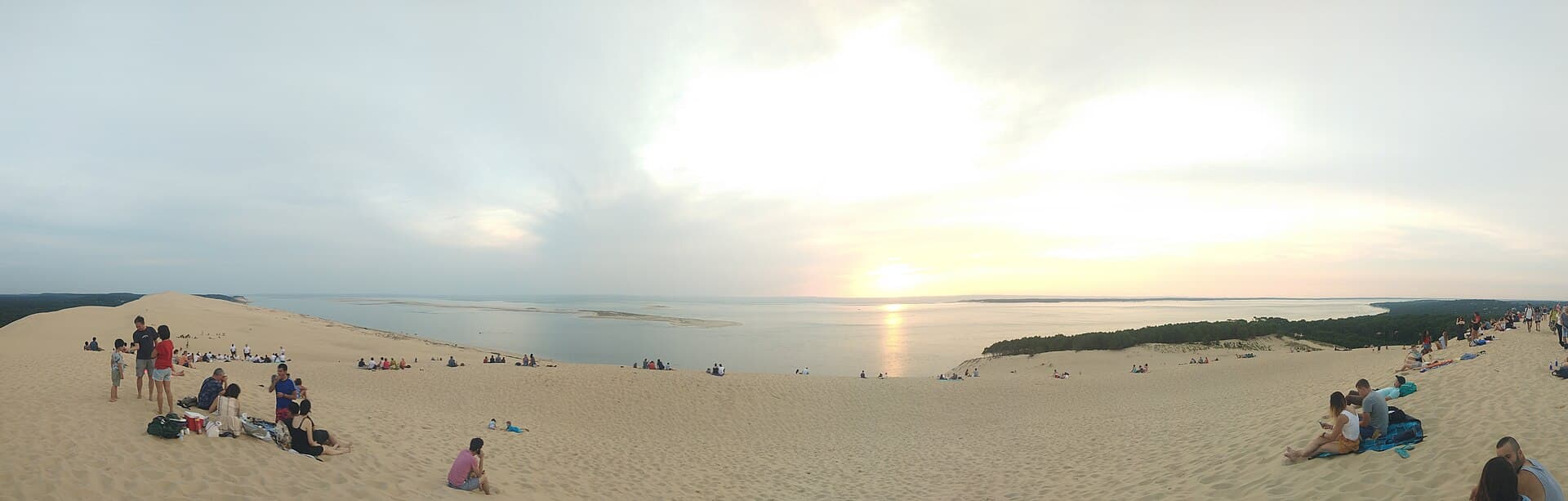
The Arcachon Bay and Pilat Dune are 1h from Bordeaux. The dune (110 m high, 2.7 km long, 500 m wide, 60 million m³ of sand) is Europe's highest — spectacular view at the top over the Bay on one side and the Landes forest (1.1 million hectares, Western Europe's largest forest) on the other. The Bay is visited by boat (cruises from Arcachon, Cap Ferret, Andernos): île aux Oiseaux and its stilted cabanes tchanquées, Banc d'Arguin (ornithological reserve), tip of Cap Ferret (oyster village). Arcachon city (Ville d'Été, Belle Époque Ville d'Hiver, Pereire beach) deserves a day.
The Basque coast stretches 35 km between Biarritz and the Spanish border. Biarritz (imperial resort created by Eugénie de Montijo in 1854) unfolds its Belle Époque villas, its Hôtel du Palais (iconic palace), the Rocher de la Vierge and its tunnel, the Grande Plage (urban surfing, Surf Festival), the Musée de la Mer. Saint-Jean-de-Luz with its picturesque port, Saint-Jean-Baptiste church (Louis XIV's marriage), the Maison Louis XIV. Hendaye for family beaches. Bayonne for the preserved historic centre (Petit Bayonne, French Quarter, Sainte-Marie Cathedral) and the Fêtes de Bayonne festival (5 days late July, 1 million visitors in white-red attire).
The Basque hinterland unfolds its green villages and mountains: Espelette (AOP pepper capital, façades adorned with strings of red peppers in September), Sare and Ainhoa (classified Most Beautiful Villages), Saint-Jean-Pied-de-Port (Vauban citadel, starting point of the Camino francés to Santiago de Compostela), Pic de la Rhune (905 m, accessible by rack railway from Sare). The Rhune train (€60 for 4 people, 35 min ascent) offers an exceptional panorama of the Basque coast and Pyrenees.
Beyond: Périgord (Sarlat, Lascaux 4, Dordogne châteaux, foie gras), La Rochelle (fortified city, old port, île de Ré), Cognac (cognac houses: Hennessy, Martell, Rémy Martin), Pyrenees-Atlantiques (Pic du Midi d'Ossau, Aspe Valley, national park).
Read also
- Bordeaux, world capital of wine — UNESCO Port of the Moon, Cité du Vin, water mirror and direct access to vineyards.
- Biarritz, pearl of the Basque Coast — Imperial resort, surfing, Basque gastronomy and Belle Époque villas.
- France — Complete country guide: entry rules, regions, budget, gastronomy.
- Occitanie — UNESCO Carcassonne, Toulouse and Pyrenees just to the east.