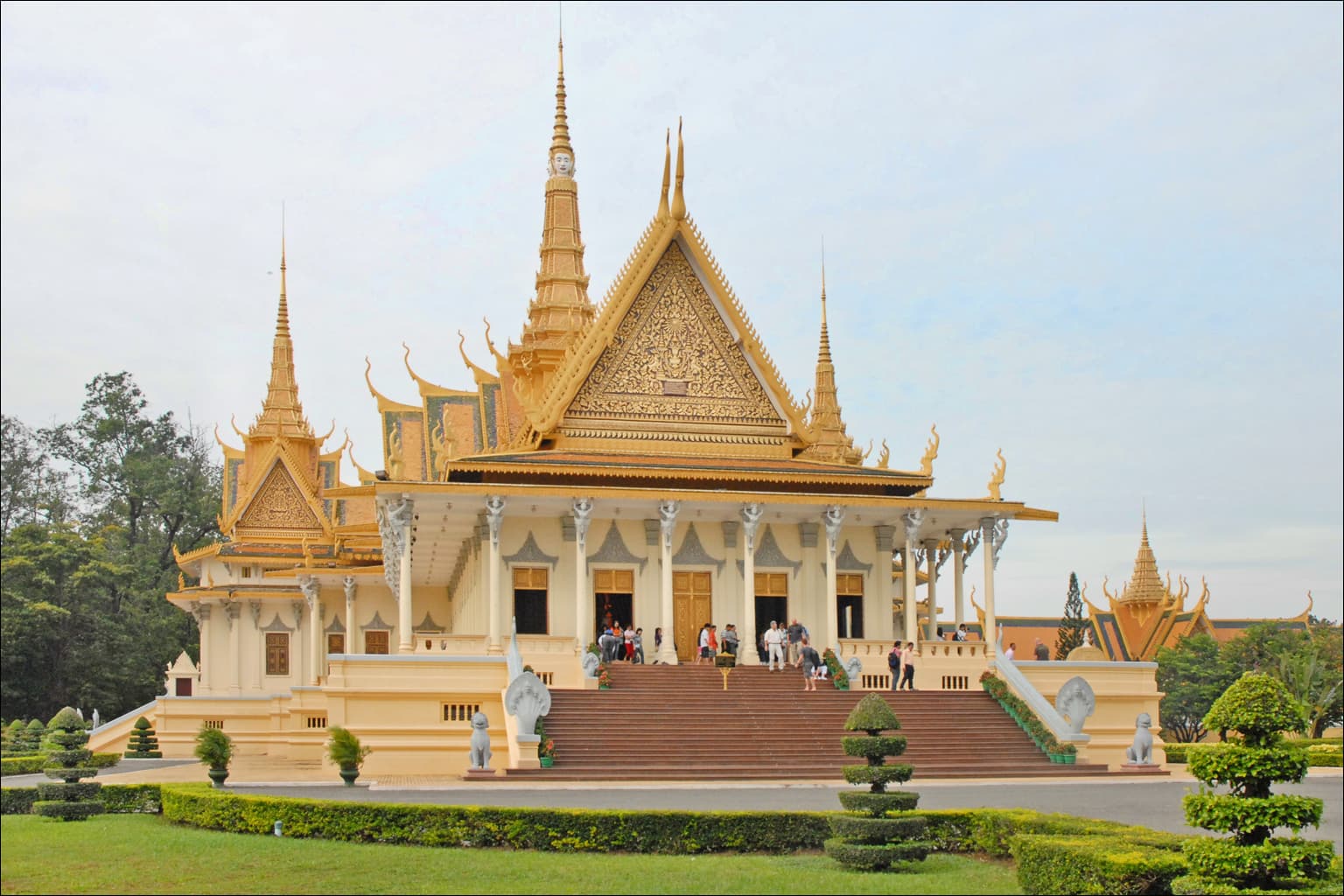
The Phnom Penh and the South region covers the capital of Cambodia and the adjacent south-eastern provinces up to the south coast limits. It's the historical, memorial and contemporary dimension of the Cambodian trip — that of the painful memory of the Khmer Rouge genocide (1975-1979), the residual splendour of the Khmer monarchy, the effervescence of a capital in transformation, and the francophonie inherited from the French protectorate (1863-1953).
Phnom Penh (1.5 million inhabitants, agglomeration of 2.3 million) extends at the strategic confluence of three rivers: the Mekong, the Tonle Sap River (which changes flow direction twice a year, a phenomenon unique worldwide), and the Bassac. This strategic position made its fortune in the colonial era — the French installed their administrative protectorate there in 1865, transforming a village into the "Pearl of Asia", capital of French Indochina at certain periods, an elegant city with wide boulevards and stucco colonial villas.
The recent history of the city is dramatic. On 17 April 1975, the Khmer Rouge entered Phnom Penh and evacuated the city in 72 hours — 2 million inhabitants forced to walk to the countryside for "re-education" and forced labour. For nearly 4 years, Phnom Penh would be a ghost city. At the Vietnamese liberation in January 1979, the population gradually returned, but the scar remains vivid. The S-21 torture centre (former high school turned prison) and the Choeung Ek Killing Fields testify to this period — essential memorial stops to understand the country.
Today, Phnom Penh is in full mutation. Chinese skyscrapers pushing up quickly, monstrous traffic jams, emerging middle classes consuming in new malls (Aeon Mall, Olympia Mall), a culinary scene sophisticating (high Khmer gastronomy at Romdeng, Friends the Restaurant, Malis, Mok Mony). The riverside (3 km of landscaped quays on the Tonle Sap) is the tourist backbone — restaurants, rooftop bars, excursion boats, boutique hotels.
Read also
- Phnom Penh — The capital: Royal Palace, S-21, Killing Fields, Mekong riverside.
- Cambodia — Complete country guide: visa, currency, regions, best time to visit.
- Siem Reap and Angkor — The Angkor archaeological site (UNESCO) — to combine with Phnom Penh in 8-10 days.
- Cambodian south coast — Kampot, Kep, Koh Rong islands: the beach dimension — accessible from Phnom Penh.