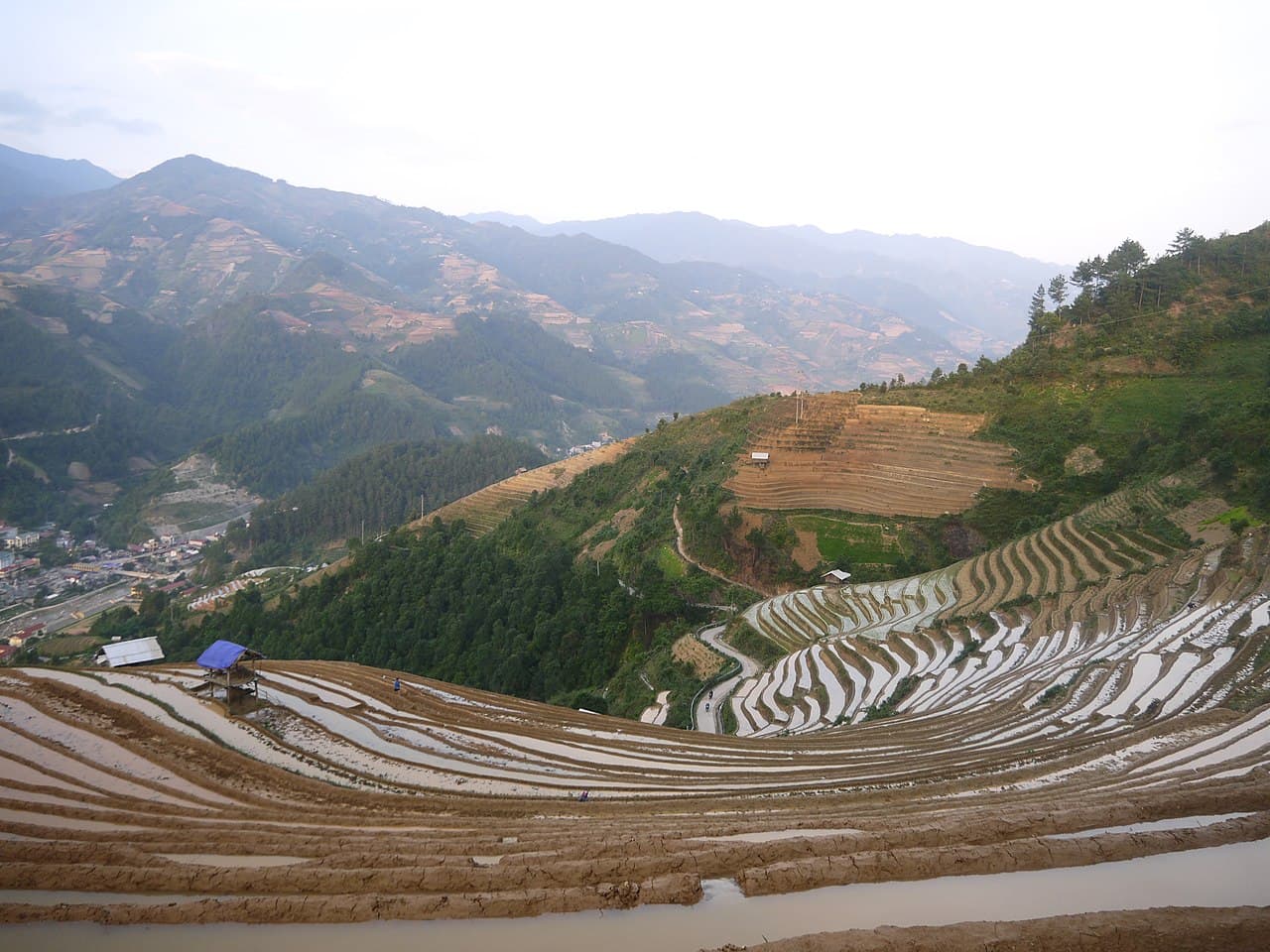
Getting around North Vietnam means adapting your mode of transport to each sub-region: traffic conditions, distances and road quality vary enormously between the city, the coast and the mountains.
In Hanoi, Grab is by far the most practical and transparent option for city trips — fixed price in advance, no haggling, geolocated drivers. For short distances in the Old Quarter, walking is preferable: the lanes are impassable by car at rush hour. Taxi Group and Mailinh taxis are reliable with meters; avoid all others.
To reach Ha Long Bay from Hanoi (160 km, 3h30-4h), most cruises include transfer by air-conditioned bus. If you are booking independently, direct buses (Hung Thanh, Duc Duong) leave from Giap Bat Bus Station.
For Sapa, the overnight train Hanoi–Lào Cai (departure around 9-10 pm, arriving at 6-7 am) is the recommended option: comfortable 4-berth soft-sleeper cabins (book via 12go.asia or at Hanoi station), 25-50 USD. The VIP bus (Fansipan Express, Sapa Bus) takes 4h30 from My Dinh Bus Station — practical but winding after Lào Cai. By motorbike, National Road 4D between Lào Cai and Sapa is spectacular but demanding.
For the Ha Giang circuit, motorbike is the only way to truly experience the Dong Van loop: hire one in Ha Giang town (150,000-200,000 VND/day) or join a guided tour with a local Easy Rider. Roads are wide and well-maintained between Ha Giang and Dong Van, then narrower and more vertiginous beyond. Allow a minimum of 4 days for the full loop. For Cao Bang and the Ban Gioc waterfall, minibus or private car with driver from Hanoi (5-6 hours).
Read also
- Hanoi, Vietnam's thousand-year-old capital — The Old Quarter, Hoan Kiem Lake, legendary street food and Franco-Vietnamese architecture.
- Ha Long Bay — 1,969 limestone islets in an emerald sea — one of Asia's most beautiful landscapes.
- Vietnam — Complete guide: visa, budget, north-centre-south circuit and best time to visit.
- Central Vietnam — Hoi An, Hue and Da Nang's beaches — Vietnam's imperial and colonial soul.