
Expert on Vietnam · 1 contributions
 South-East Asia Desk — Mowando·Editor
- · First trip to Vietnam with full north-to-south coverage
- · Couples or friends seeking UNESCO culture, sea and gastronomy
- · Travellers comfortable with domestic flights and boats
February, March, April, November, December
The right split at 15 days: 3 nights in Hanoi, 1 night on a Halong Bay cruise, 3 nights in Hoi An, 3 nights in Ho Chi Minh City, 2 nights in the Mekong Delta. Two domestic flights (Da Nang → HCMV) absorb the north-south distances, and the Halong cruise must be booked weeks ahead for any quality boat.
Day by day
- 1Day 1
Arrival in Hanoi — first evening in the Old Quarter
Land at Noi Bai International Airport (HAN), 35 km from the centre. Bus No.86 express to the Old Quarter (45 min, 35,000 VND / €1.30) — the most economical option from the airport. Alternative: Grab taxi (essential app in Vietnam) for 200,000-250,000 VND / €7-9, no negotiation, GPS-tracked — far preferable to street taxis.
Settle into the Old Quarter (Hoàn Kiếm) — the ideal base: 36 guild streets within walking distance, lakes, temples and street breweries at every turn. First move of the evening: sit down at a bia hoi (pavement brewery, draught beer at 5,000-10,000 VND / €0.20-0.40) on the corner of Tạ Hiện and Lương Ngọc Quyến, the neighbourhood's liveliest street. A bowl of bún chả (grilled pork vermicelli, 50,000-70,000 VND / €2-2.50) as a first Vietnamese meal.
Tips- · Download the Grab app before departure — it is the only reliable way to get around without being overcharged in Vietnam, in Hanoi as much as any other city.
- · Best area to stay: Hoàn Kiếm, within 500 m of the lake — good selection of boutique hotels between €25 and €60 per night, breakfast often included.
- 2Day 2
Hanoi: Old Quarter, Hoan Kiem Lake and train street
The orientation day. Walk from the hotel to Hoan Kiem Lake — full circuit of the lake (40 min), stop at Ngoc Son Temple on its islet connected by the red Huc Bridge (30,000 VND / €1.10). The lake's giant turtle died in 2016, but its shell is displayed inside the temple.
Explore the 36 guild streets: each historic street still bears the name of its craft specialty (paper street, tin street, silk street). The quarter is dense, loud and alive — getting lost is the plan. Essential lunch: phở bò at Phở Gia Truyền (49 Bát Đàn, queue expected, 60,000-80,000 VND / €2.20-2.90) — Hanoi's best beef pho according to locals.
Train Street in late afternoon (Lê Duẩn street, access from Đinh Lễ): twice daily (around 3:30pm and 7:30pm), a train passes 50 cm from the houses along the alley — a unique spectacle, with restaurants and cafés on the tracks reopened after the 2019 closure. Arrive 30 minutes before the train.
Tips- · Hanoi pho is a morning food — most historic spots close between 10am and 2pm. Plan for morning pho on Day 2 or 3 rather than lunch.
- · Train Street: do not step onto the rails as the train approaches — security agents push back anyone too close; the incident can ruin the moment.
- 3Day 3
Hanoi: Ho Chi Minh Mausoleum, Temple of Literature, street food
Second day in Hanoi — monumental and gastronomic. Leave at 7:30am for the Ho Chi Minh Mausoleum (free, open Tue-Thu + Sat-Sun 8am-11:30am) — expect a queue, smart-casual dress required (no shorts, shoulders covered), silence inside. Nearby: Ho Chi Minh's stilt house (25,000 VND) and the Presidential Palace Museum, set in a beautiful park.
Morning: Temple of Literature (Văn Miếu, 30,000 VND / €1.10) — founded in 1070, Vietnam's first university, stone turtles bearing laureate doctoral tablets. The quintessence of Lý architecture. Lunch: bún bò Hanoï or bánh mì at Đồng Xuân covered market (Hanoi's largest market, 3 floors, 2,000 stalls).
Free afternoon for silk shopping in the Old Quarter or the Museum of Ethnology (Museum of Vietnam, 40,000 VND, Cầu Giấy district) — the best introduction to the country's 54 ethnic groups. Evening: gastronomic Vietnamese dinner at Chả Cá Thăng Long (turmeric-dill fish specialty, 150,000-200,000 VND / €5.50-7.30) or fresh nem cuốn spring rolls in the Old Quarter.
Tips- · The mausoleum is closed during annual maintenance (typically Sept-Nov) — check the official calendar before planning your trip.
- · Silk shops in the Old Quarter (Hàng Gai street) charge 2-3x more than the nearby Đồng Xuân market for the same quality — negotiate or compare.
- 4Day 4
Hanoi → Halong Bay cruise: boarding
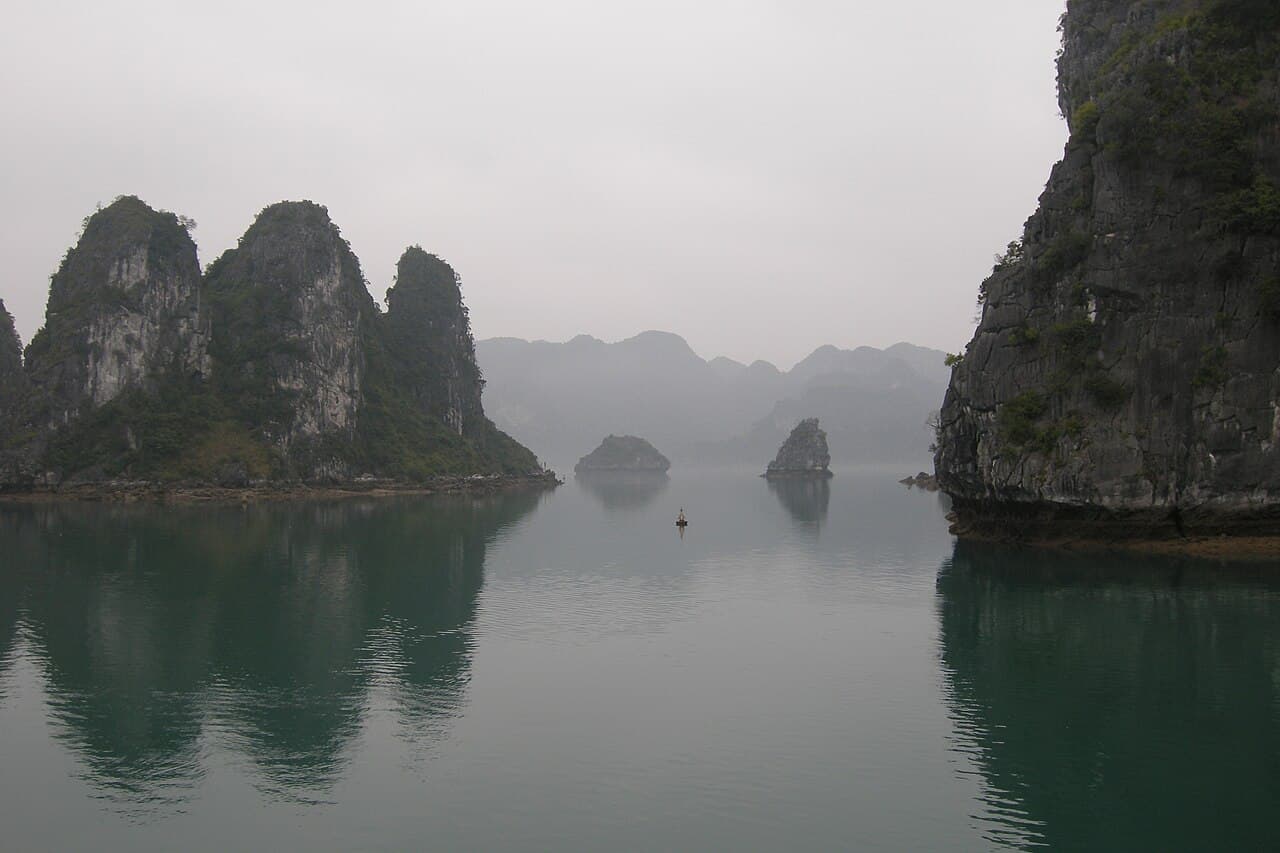
Depart by bus from Hanoi to Tuần Châu or Cái Rồng port (3h30-4h, transfer included in most cruise packages). Board between 11:30am and noon. Halong Bay — 1,969 limestone islets rising from the South China Sea, UNESCO-listed since 1994 — is one of Asia's most spectacular landscapes. The first glimpse from the boat deck, surrounded by karst towers, is unforgettable.
Afternoon on deck: sailing between limestone pinnacles, kayaking in hidden lagoons, visiting Sung Sot Cave (Cave of Surprises, the bay's largest, 150,000 VND included in the package). Sunset at sea with islets silhouetted against the sky — the circuit's signature moment. Dinner on board (fresh seafood, Vietnamese cuisine, 3-4 courses), overnight on the boat in the bay. The nighttime silence of the bay, surrounded by karst towers, justifies the two days on the water on its own.
Cruise budget 2 days/1 night: €120-180 in mid-range (3-star boat, double cabin, meals included). Avoid boats under €80 — comfort and safety are insufficient. Book through a certified agency (Indochina Junk, Paradise Cruises, Bhaya Cruises for premium; Era Cruises, Stellar Cruises for mid-range).
Tips- · Book the cruise at least 3 weeks ahead in high season (Nov-Mar) — quality boats sell out long before departure. Weekday departures are 15-20% cheaper.
- · Halong Bay vs Bai Tu Long Bay: Bai Tu Long (the adjacent bay, less known) is virtually identical visually but 3x less crowded — ask the agency if they offer cruises in this area.
- 5Day 5
Halong Bay cruise: morning at sea → return to Hanoi
Wake up at sea, in the morning mist wrapping the limestone towers. Most quality boats offer tai chi at sunrise on the upper deck (5:45-6:30am) — the exercise is symbolic, but the setting is striking. Breakfast on board, then activities depending on the boat: Vietnamese cooking class (making your own nem cuốn), visit to a floating fishing village, or snorkelling if visibility allows (varies by season).
Cabin check-out at 9:30am, farewell lunch on board, return to port around noon-1pm. Bus back to Hanoi (3h30-4h), arriving late afternoon. Quiet evening in Hanoi, or evening departure to the airport for those connecting directly to Da Nang without an extra Hanoi night. If time allows: Old Quarter night market (Friday-Sunday, Hàng Đào street, 6pm-11pm) — clothing, crafts, street food.
Tips- · Morning mist over Halong Bay is most dramatic from November to March — visually spectacular, but overnight temperatures can drop to 12-15 °C in January; pack a warm layer.
- · Sapa note: if you have a spare day in Hanoi at the start or end of your trip, Sapa's terraced rice fields (overnight train 8h, €25-40 in a sleeper) are the best northern add-on.
- 6Day 6
Hanoi → Da Nang flight → Hoi An transfer
Domestic flight Hanoi (HAN) → Da Nang (DAD), 1h15, €30-70 depending on airline and booking lead time — Vietnam Airlines, VietJet Air and Bamboo Airways serve the route multiple times daily. Book at least 2 weeks ahead. Da Nang is the regional airport for Central Vietnam, 30 km from Hoi An.
Airport → Hoi An transfer: shared taxi or shuttle (150,000-200,000 VND / €5.50-7.30 per person) — agencies at the airport run minibuses, or book through your hotel. Arrive in Hoi An early afternoon. Time to settle in, then first walk through the UNESCO Old Town before sunset. The Japanese Covered Bridge (Lai Viễn Kiều), dating from the 17th century, is iconic — and photographed endlessly. Inaugural dinner: Cao Lầu (local specialty of thick noodles with roast pork and croutons, 60,000-80,000 VND / €2.20-2.90), a dish found only in Hoi An according to legend (Cham well water required for the dough).
Tips- · Da Nang has its own attractions (Dragon Bridge, Marble Mountains) — if schedule permits, a 3h stop between the airport and Hoi An is worth visiting the Marble Mountains (Ngũ Hành Sơn, 40,000 VND, elevator included).
- · Hoi An in high season (Nov-Feb): book a hotel inside or just outside the Old Town — riverside Thu Bon properties (with lantern views) go first.
- 7Day 7
Hoi An: UNESCO Old Town and bespoke tailor
A day in central Vietnam's jewel. Hoi An Old Town (access ticket 120,000 VND / €4.40 including 5 of 21 sites) is Southeast Asia's most complete ancient merchant city — Chinese, Japanese, French and Vietnamese trading houses coexist in buildings three centuries old. Must-sees included in the ticket: Phúc Kiến Assembly Hall (the most ornate), Tấn Ký Ancient House (the defining Hoi An architectural example), the Japanese Covered Bridge.
Hoi An is the world's capital of rapid bespoke tailoring: 700 tailors in town, a shirt in 24h, a suit in 48h, an evening dress in 72h. Prices: shirt €20-40, suit €100-200 depending on fabric. Reliable addresses: Yaly Couture (109B Nguyễn Thái Học, international reputation), A Dong Silk (62 Trần Phú). Golden rule: fitting at J+1 for adjustments, collection at J+2. Order the moment you arrive in Hoi An, not the day before leaving.
Evening: paper lanterns light up the old town from 6pm. First evening of the month (lantern festival, full moon) — if it coincides with your visit — the old town is lit only by candles and lanterns, electricity switched off.
Tips- · The Old Town ticket is checked at the entrance to each included site — buy it on arrival at the tourist office on Trần Phú (not at individual site doors, which is less convenient).
- · Hoi An tailors work from photos — bring a reference image of the garment you want on your phone: the result is far closer to expectations.
- 8Day 8
Hoi An: An Bang Beach and My Son temple complex
A balanced day between beach and heritage. Morning: An Bang Beach, 4 km from Hoi An centre (bicycle rental, 50,000 VND / day — the best way to get around Hoi An). An Bang is Hoi An's local beach, less well known than Cửa Đại, with accessible seafront restaurants (bánh xèo Vietnamese crepe, 60,000-80,000 VND). Swimming is viable from October to June in central Vietnam (relatively calm sea).
Afternoon: scooter or taxi excursion to My Son (35 km, 1h), a Cham temple complex from the 4th to 14th centuries, UNESCO-listed. Over 70 red brick structures in a narrow valley — Vietnam's equivalent of Angkor, on a more intimate scale. Entrance 150,000 VND / €5.50. Arrive at 2-2:30pm, after the morning groups have left, to enjoy the site nearly empty. Leave before 5pm (closing). Hué note: if time allows, a day trip to Hué's Imperial Citadel (130 km north of Hoi An) adds considerable depth to the circuit — transfer by bus (3h) or private car.
Tips- · My Son in the morning with a guide means 50 people shoulder to shoulder. Alone in the afternoon means a nearly empty site for the same price — the visiting time makes all the difference.
- · Bicycle rental in Hoi An (50,000 VND / day) is perfect transport for the Old Town and An Bang — scooters are banned in the historic centre between 8-11am and 2-5pm.
- 9Day 9
Hoi An: cooking class, market and Old Town by night
Gastronomic day and leisurely strolling. Vietnamese cooking class (half-day, 400,000-700,000 VND / €15-26, market included) — the classic formula starts at Hoi An central market (Chợ Hội An) at 8am to identify herbs, vegetables and fresh fish, then cook 3-4 typical dishes: white rose (bánh vạc), cao lầu, nem cuốn, chè. Well-regarded schools: Red Bridge Cooking School (boat to the school along the Thu Bon), Morning Glory.
Free afternoon to collect clothes from the tailor, wander the Old Town's alleys or take a cyclo through the pottery village of Thanh Hà (4 km, 25,000 VND entry). Last evening in Hoi An: dinner at Morning Glory restaurant (106 Nguyễn Thái Học, refined regional cuisine, 150,000-250,000 VND per dish) then a lantern walk along the Thu Bon — vendors offer floating lanterns to release on the water (20,000 VND, wish included by tradition).
Tips- · Hoi An cooking classes are among Asia's best — choose a school that genuinely teaches techniques (knife skills, cooking times, flavour balance) rather than just assembly.
- · Final clothing check before leaving: inspect seams, buttons and fit in daylight — tailors generally accept last-minute alterations until 8pm.
- 10Day 10
Hoi An → Da Nang flight → Ho Chi Minh City
Morning transfer by taxi or shuttle from Hoi An to Da Nang Airport (30-40 min, 200,000-300,000 VND). Da Nang (DAD) → Ho Chi Minh City (SGN / Tân Sơn Nhất) flight, 1h20, €25-60 — VietJet Air, Vietnam Airlines and Bamboo cover the route hourly. Book when planning the trip.
Arrive at Tân Sơn Nhất Airport (SGN), one of Asia's busiest. Bus 109 to the city centre (20,000 VND, 45-60 min depending on traffic) or Grab (100,000-150,000 VND / €3.60-5.40 depending on time). Settle into District 1 — the city's nerve centre, between Ben Thanh Market, Notre-Dame Cathedral and the lively streets of Bùi Viện (bar district). Ho Chi Minh City, formerly Saigon, is a megacity of 10 million people — the energy is radically different from the North. First Saigon dinner: hủ tiếu Nam Vang (Cambodian-style pork noodle soup, 60,000-80,000 VND) or bánh mì on a street corner.
Tips- · Ho Chi Minh City traffic is Vietnam's most intense — Grab motorbike (xe ôm) is 2x faster than a Grab car during rush hours (7-9am, 5-7pm) for short trips in District 1.
- · Bùi Viện Street (the backpacker street) is lively but loud at night — prefer a hotel 200 m away for the noise environment, while keeping access to nightlife.
- 11Day 11
Ho Chi Minh City: Cu Chi tunnels and Reunification Palace
A day of history and memory. Morning: Cu Chi tunnels excursion (60 km from the centre, 1h30 by bus, organised day trip recommended 8am-2pm, 300,000-400,000 VND / €11-14.60 including transport). The Cu Chi tunnels form a 250 km underground network dug by the Viet Cong during the Vietnam War — astonishing survival engineering. Guided tour (EN/FR), descent into tourist-widened tunnels (50 cm diameter, 80 cm height), demonstration of bamboo traps. Those with claustrophobia can skip the descent and only visit the outdoor installations.
Return to the city early afternoon. Reunification Palace (135 Nam Kỳ Khởi Nghĩa, 40,000 VND / €1.50, open 7:30am-noon and 1-5pm) — former presidential palace of the Republic of South Vietnam, stormed on 30 April 1975 by Northern tanks. The interior has remained intact since 1975: reception rooms, underground bunker, military communications room. Recommended visiting time: 1h30. Evening: dinner at Cục Gạch Quán (10 Đặng Tất, Vietnamese home cooking in a colonial villa, book ahead, 150,000-250,000 VND per dish).
Tips- · A half-day Cu Chi tour (depart 8am, return 1pm) exists and frees the afternoon for the Reunification Palace — confirm the half-day format with the agency, not all offer it.
- · At the Reunification Palace, ask for the French-language audio guide (included in entry) — the contextual war explanations are far more complete than the panels alone.
- 12Day 12
Ho Chi Minh City: War Remnants Museum, Ben Thanh Market
Morning at the War Remnants Museum (28 Võ Văn Tần, 40,000 VND / €1.50, open 7:30am-6pm) — one of the world's most moving and difficult museums. Nick Ut's photos (Napalm Girl), Agent Orange exhibition, American military hardware in the courtyard (helicopters, tanks, aircraft). Allow at least 2h. The museum is explicitly from the Vietnamese perspective — a natural complement to the Cu Chi tunnels for understanding the war from both sides.
Lunch in District 3 then head to Ben Thanh Market (Chợ Bến Thành, District 1, open 6am-6pm) — the city's most iconic market, spread across 13,000 m²: food, spices, fabrics, crafts, souvenirs. Prices are marked but negotiable (start at 60% of the displayed price). The night market (around Ben Thanh, 6-11pm) is livelier and less touristy for street food.
Optional evening: rooftop bar EON Heli Bar (52nd floor Bitexco Tower, 360° city view, cocktail 200,000-300,000 VND) or traditional Vietnamese music concert at the Conservatoire de Musique (open to the public some evenings, programme on site).
Tips- · The War Remnants Museum is emotionally draining — don't schedule an intense activity right after. A walk through the adjacent Tao Đàn Park (free, shaded) is the best decompressor.
- · Ben Thanh Market: food hall vendors (herbs, spices, Vietnamese coffee) are less open to negotiation than the souvenir section — a good place to buy cà phê chồn (weasel coffee) or Phú Quốc pepper.
- 13Day 13
Mekong Delta: 2-day/1-night homestay excursion departure
Early departure (8am) from Ho Chi Minh City by bus or private van to the Mekong Delta (90-120 km depending on destination, 2h drive). The delta is one of the world's most productive river deltas — 20 million inhabitants, endless rice paddies, interlaced Mekong branches, floating markets. The 2-day/1-night excursion with a homestay is the most authentic experience of this itinerary.
Day 13 programme: arrive at Mỹ Tho or Bến Tre (coconut capital), transfer by rowboat along the Mekong's small tributaries, visit to a coconut candy workshop, a bonsai nursery, honey tasting and tropical fruit sampling (longan, rambutan, jackfruit) at a producer. Overnight in a homestay (200,000-350,000 VND / night / person, meals included) — simple but clean room, mosquito nets provided, shared bathroom. Family dinner with the hosts.
Tips- · Choose a tour with a French or English-speaking guide for homestays — without an interpreter, communication with host families is impossible and the experience loses 80% of its richness.
- · The delta is hot and humid year-round (30-34 °C) — bring mosquito repellent (essential in the evening), sunscreen and light long-sleeved clothing for rowboat trips.
- 14Day 14
Mekong Delta: Cái Bè floating market → return to HCMV
Wake before dawn (5:30-6am) for the Cái Bè floating market — fruit and vegetable vendors gather by boat at first light, hanging their produce from a pole to signal what they sell (the Mekong floating market tradition). Activity dies down after 8am — the early wake-up is non-negotiable. Boat trip through secondary canals between islands, fruit orchards, pottery villages and a pagoda-house to visit.
Return by van to Ho Chi Minh City late morning (arriving around 1-2pm). Free afternoon in District 1 for last-minute shopping or visiting the Thiên Hậu Pagoda (Chinatown, District 5, Chợ Lớn — the world's largest Chinatown outside China, xe ôm visit recommended). Farewell dinner at Nhà Hàng Ngon (160 Pasteur, District 3 — central courtyard of a colonial villa with 30 street food stalls under one roof, 100,000-200,000 VND per dish).
Tips- · Chợ Lớn (District 5) deserves half a day on its own — Saigon's Chinese quarter, founded in the 18th century, has a completely different atmosphere and architecture from District 1.
- · Recommended pre-departure purchases: ground Vietnamese coffee (Trung Nguyên or Ca Phê Thu Hà), Chinsu chilli sauce, Phú Quốc fish sauce (nước mắm) in a sealed bottle for the flight.
- 15Day 15
Ho Chi Minh City → international flight
Last Vietnamese morning: wake according to your flight time, last-minute street breakfast — bánh mì warm from any pavement stall (20,000-30,000 VND / €0.70-1.10) or iced Vietnamese coffee (cà phê đá, 25,000-40,000 VND) at a District 1 café. Last-day rule: allow at least 3h between hotel and boarding gate at Tân Sơn Nhất (SGN) — the airport is congested on weekdays, check-in and security queues can exceed 45 minutes.
Transfer to the airport: Grab car recommended (150,000-250,000 VND depending on time, 30-50 min outside rush hour). Return flights to Europe: Paris CDG from HCMV in 11-13h (stopovers in Doha, Dubai, Singapore, Bangkok or direct depending on airline). Vietnam Airlines, Qatar Airways, Emirates, Singapore Airlines and Thai Airways cover Europe from SGN. Final tip: don't forget to declare nước mắm in checked luggage (liquids over 100 ml prohibited in cabin) and keep a small reserve of VND for drinks and snacks airside.
Tips- · Tân Sơn Nhất Airport is Vietnam's busiest — avoid Friday and Sunday evening departures (weekly peaks), and allow 3h30 for international connections with an overseas stopover.
- · Leftover currency: Vietnamese dong (VND) is virtually non-convertible abroad — spend the remainder at the airport duty-free or restaurants before the flight.
Other durations
Frequently asked questions
Faut-il un visa pour entrer au Vietnam depuis la France ?+
Comment réserver des vols intérieurs fiables au Vietnam ?+
Comment choisir une croisière Halong Bay fiable et éthique ?+
Quelle est la différence de climat entre le nord et le sud du Vietnam en novembre-mars ?+
Peut-on circuler à moto au Vietnam en tant que touriste étranger ?+
Combien coûte un repas au Vietnam et quel est le budget quotidien réaliste ?+
Faut-il des vaccins particuliers pour aller au Vietnam ?+
Que faire si on a seulement 10 jours au lieu de 15 au Vietnam ?+
Hanoï ou Ho Chi Minh Ville pour arriver en premier ?+
Y a-t-il des risques de sécurité particuliers à connaître au Vietnam ?+
Our verdict
This 15-day Vietnam itinerary is the ideal duration to cover the country from north to south without sacrificing any of its iconic stages: Hanoi for historical depth and gastronomy, Halong Bay for the great natural spectacle, Hoi An for UNESCO heritage and tailoring, Ho Chi Minh City to understand contemporary Vietnam and the memory of war, and the Mekong Delta to touch the country's rural reality.
The two domestic flights (Hanoi → Da Nang and Da Nang → Ho Chi Minh City) are the circuit's smartest investment — they save 20h of all-inclusive train or bus travel and allow each day to focus on actual exploration. The 2-day/1-night Halong cruise absolutely warrants the mid-range level (€120-160): budget boats overcrowd the sites and the night at sea in the bay, in silence under the stars, is one of Asia's most memorable experiences.
This circuit works because it refuses to dilute itself. Sapa, Hué, Nha Trang, Đà Lạt and Phú Quốc island are real and worthwhile destinations — but adding them to this 15-day trip turns every stage into a transit. Vietnam deserves at least two trips: the first to lay this north-south foundation, the second to explore the depth of Central Vietnam or the southern islands. Properly prepared — cruise booked 3 weeks ahead, domestic flights booked early, tailors consulted on the first day in Hoi An — this journey is among the richest Southeast Asia can offer.
Read also
- When to visit Vietnam — Seasons, monsoon and best windows by region — north, centre and south.
- Vietnam budget — How much to plan per day depending on cities, regions and comfort level.
- When to visit Hanoi — Cool season, winter haze and Tết festivals — month by month.
Written by La rédaction · Updated 5/29/2026
Vietnam