Seville concentrates its major monuments in a remarkably compact historic centre, allowing everything to be visited on foot.
The Seville Cathedral — the largest Gothic cathedral in the world — was built on the foundations of the twelfth-century Almohad great mosque. Its tower, the Giralda, a former minaret converted into a bell tower, is the city's defining symbol: the ascent (via a spiral ramp with no stairs, wide enough for mounted horses) offers a panoramic view over the entire city. Inside, the tomb of Christopher Columbus (his purported remains) is borne by four royal statues in the central nave.
The Alcázar (Real Alcázar de Sevilla) is one of Europe's most beautiful royal palaces — and the oldest still in active use. A fourteenth-century Mudéjar construction commissioned by King Peter I ('the Cruel') from Moorish craftsmen from Granada, its carved stucco facades, azulejo-tiled courtyards and jasmine-scented gardens compose a masterwork of Hispano-Moorish architecture. The visit includes the royal apartments, the Patio de las Doncellas and the terraced gardens — allow a minimum of two hours.
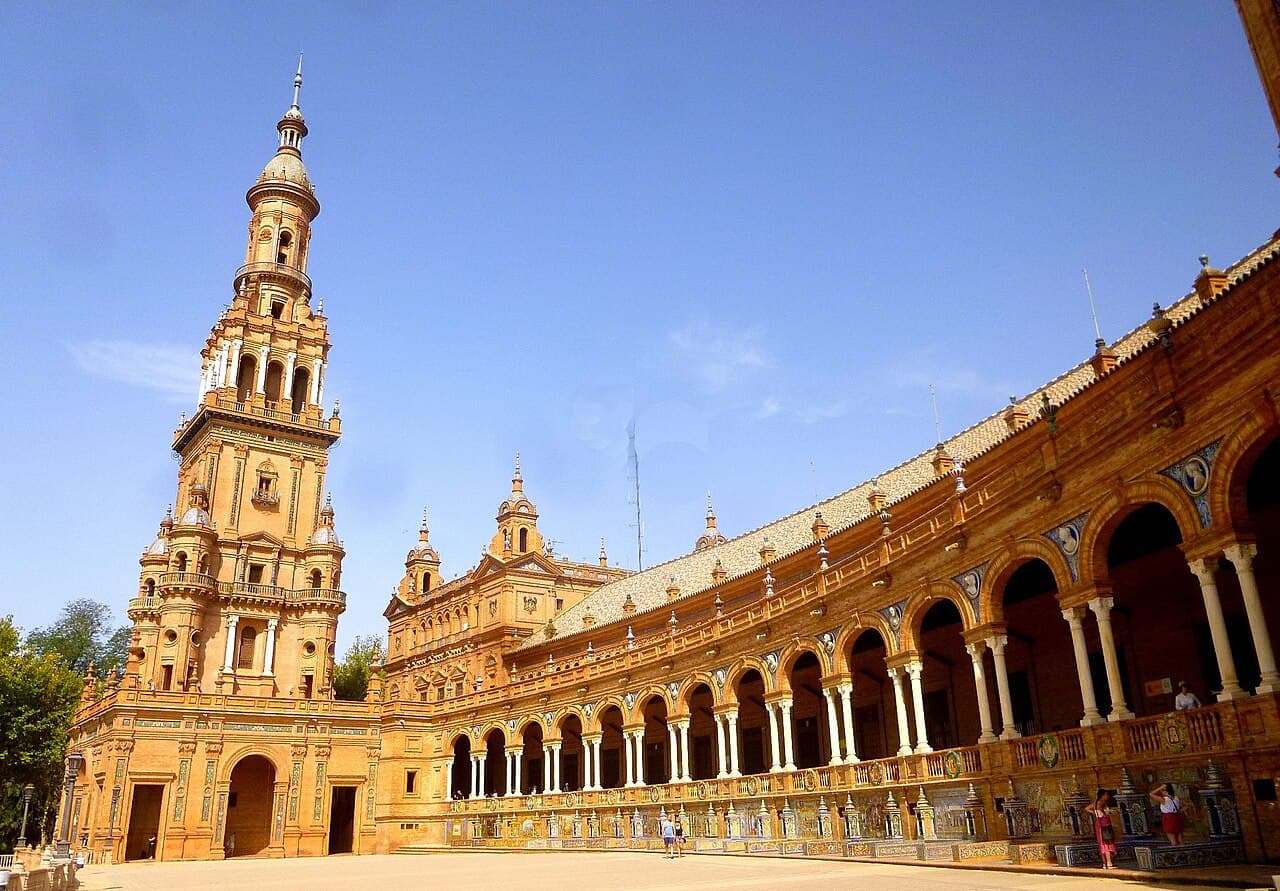
The Plaza de España (1929, designed for the Ibero-American Exposition) is one of Europe's most beautiful squares: a 200-metre semicircular colonnade borders a canal spanned by five bridges and lined with tiled benches representing Spain's 48 provinces. A boat ride on the canal (€2) gives the finest perspective on the colonnade.
The Triana quarter, across the Guadalquivir, is Seville's popular soul. The birthplace of most of the great Sevillian flamenco dynasties, it holds the Triana market (fish, produce and local crafts), the Calle Betis (bars with river views) and the azulejo ceramic workshops whose blue-and-yellow tiles ornament the city's finest buildings. An evening in Triana's tapas bars is non-negotiable.
A flamenco tablao performance is one of the most intense experiences in any Seville trip. Sevillian flamenco — with its seguiriyas, soleares and bulerías — is the most sophisticated in Andalusia. Professional tablaos offer 75- to 90-minute shows with high-calibre guitarists, cantaoras and bailaoras. La Carbonería (Calle Levíes, Santa Cruz) hosts free sessions some evenings — quality varies, but the atmosphere is authentically local.
The Roman ruins of Italica (9 km north-west, accessible by bus from Plaza de Armas) merit half a day: founded in 206 BC by Scipio Africanus, Italica was the birthplace of emperors Trajan and Hadrian. The amphitheatre (the third largest in the Roman Empire) and the patrician house mosaics are remarkably well preserved, and the site can be visited in welcome peace and quiet.
Read also
- Andalusia — Granada, Córdoba, Málaga, Ronda and the Pueblos Blancos — the great south of Spain.
- Granada and the Alhambra — The Nasrid palace, the Albaicín, Sacromonte and Spain's unique free tapas tradition.
- Spain — Complete guide: entry requirements, budget, regions and the best time to visit.
- Barcelona — Gaudí, the Sagrada Família and Mediterranean beaches in cosmopolitan Catalonia.