
Expert on Morocco · 1 contributions
 Africa & Americas Desk — Mowando·Editor
- · Travellers with two full weeks wanting a comprehensive circuit
- · Photography enthusiasts (Chefchaouen, dunes, medinas)
- · Travellers who have already seen Marrakech and want to explore the north and desert
March, April, May, October, November
The strength of this 14-day circuit: Casablanca → Rabat → Fes → Chefchaouen → Merzouga desert → Ouarzazate → Marrakech → Essaouira. It covers imperial cities, Berber landscapes, the Sahara and the coast in one coherent journey. Don't compress the desert and Chefchaouen stages — they are the two sensory ruptures that give the whole trip its meaning.
Day by day
- 1Day 1
Arrival in Casablanca — Hassan II Mosque and first night
Land at Mohammed V airport (code CMN), 35 km from the centre. ONCF train direct to Casa-Voyageurs station: 45 min, 45 MAD / €4.50, departing hourly. From the station, taxi to the hotel (20-30 MAD / €2-3).
Casablanca is not a picture-postcard tourist destination — it's Morocco's economic capital, a metropolis of 4 million people whose true highlight is the Hassan II Mosque. Built partly over the Atlantic Ocean, it is the third-largest mosque in the world (guided entry for non-Muslims: 130 MAD / €13, visits at 9am, 10am, 11am and 2pm). Aim for a late-afternoon arrival: end-of-day light on the mosaic façade is spectacular.
Art deco district along Boulevard Mohammed V: 1930s colonial architecture, brasseries, banks. Dinner at Rick's Café (1940s Casablanca atmosphere, Franco-Moroccan cuisine, mains 150-250 MAD / €15-25) or more simply in the Gauthier neighbourhood (tagine 70-100 MAD / €7-10). Night at Kenzi Tower Hotel (350-500 MAD / €35-50) or Ibis Casablanca City Center for the budget option.
Tips- · Airport train to centre: 45 MAD (€4.50) for 45 min — far cheaper than a taxi (250-350 MAD / €25-35) and more reliable in rush hour.
- · Hassan II Mosque: guided tours for non-Muslims are in official guided groups only — book on the mosque website or arrive 30 min before the tour.
- 2Day 2
Casablanca → Rabat — administrative capital and Andalusian medina
ONCF train Casa-Voyageurs → Rabat-Agdal or Rabat-Ville: 1h, 50 MAD / €5, frequent departures. Rabat is Morocco's administrative capital, a royal city far calmer than Casablanca — a relief after the bustling arrival.
Full but manageable programme: morning, Mohammed V Mausoleum and Hassan Tower (free entry, impressive white marble and pink sandstone duo — both monuments are side by side). Afternoon, explore the Rabat medina, a UNESCO World Heritage Site — smaller than Fes or Marrakech, it's pleasant to explore alone without feeling overwhelmed. Pass through the jewellers' souk (Rue des Consuls), Almohad ramparts, Kasbah des Oudaïas (free entry, Andalusian garden, view over the Bou Regreg estuary).
Dinner in the Hassan neighbourhood or on Avenue Mohammed V: restaurant Al Marsa (fresh fish, 120-180 MAD / €12-18) or the Cosmopolitan brasserie for a more Western meal. Night in Rabat — Hôtel Farah Rabat (rooms from 400 MAD / €40) or Riad Dar Soufa for a riad experience in the medina (600-800 MAD / €60-80).
Tips- · Kasbah des Oudaïas in Rabat: arrive late afternoon for the light on the blue-and-white facades — Andalusian-Moroccan mixed architecture, less famous than Chefchaouen but equally photogenic.
- · Rabat tram: 8 MAD / €0.80 per trip, useful for reaching Agdal from the station without a taxi.
- 3Day 3
Train Rabat → Fes — arrival in the imperial city
ONCF train Rabat-Ville → Fes: 2h15, 100 MAD / €10 in 2nd class (book at oncf.ma). Recommended departure between 8am and 9:30am to arrive in Fes early afternoon and enjoy a first immersion in the medina before dinner.
Check into a riad in Fes el-Bali medina: Riad Laaroussa (from 700 MAD / €70, indoor pool), Riad Idrissy (500-700 MAD / €50-70, very central, 5 min from the tanneries), or Riad Dar Roumana for an upscale option (800-1,100 MAD / €80-110). Don't overload the afternoon: take time to get your bearings in the alleyways near the riad, enter the medina without a specific goal.
First essential landmark: the Nejjarine Fountain and its café-lined square. Mint tea on a rooftop café terrace with a view over the rooftops. Dinner at Dar Hatim restaurant (traditional Moroccan cuisine, full menu 120-160 MAD / €12-16) or more casually at Café Clock (fusion cuisine, burgers and Moroccan dishes, 70-110 MAD / €7-11, international atmosphere, wifi).
Tips- · Train Rabat → Fes: book on oncf.ma at least 2 days ahead in high season (100 MAD / €10 in 2nd class, 170 MAD / €17 in 1st) — no last-minute upgrades at the station.
- · Taxi from Fes station: expect 30-40 MAD (€3-4) to the medina — always negotiate the price before getting in, petits taxis have no meters.
- 4Day 4
Fes — Chouara tanneries, Bou Inania madrasa, medina
Fes el-Bali is the largest pedestrian medina in the Arab world — 9,400 alleyways, 300,000 inhabitants. A certified guide is strongly recommended (250-350 MAD / €25-35, half-day, booked through the riad or ONMT): without one you'll miss the craft explanations and can lose hours in the maze.
Morning: start at the Bou Inania Madrasa (entry 70 MAD / €7, 14th-century Merinid — the zellige tiles, sculpted plaster and cedarwood are among Morocco's finest). Then head towards the Chouara Tanneries: go between 9am and 11am when the light falls into the vats and artisans are at work. Enter through a leather shop to access the terrace (free, mint branch provided at the entrance). Vats of vegetable tan, saffron, indigo, poppy — an absolutely intact medieval scene.
Lunch at Restaurant Nur (contemporary Moroccan cuisine, main dishes 130-180 MAD / €13-18, reservation recommended) or at a medina eatery (harira + kefta, 50-70 MAD / €5-7). Afternoon: Fes pottery souk, dyers' souk, then climb to Borj Nord for a panoramic view over the entire medina.
Tips- · Chouara Tanneries: go in the morning between 9am and 11am — by afternoon the vats are often empty and artisans absent.
- · Certified guide in Fes: never accept an impromptu street guide — official guides carry their ONMT badge and can be booked through your riad or the ONMT office near Bab Bou Jeloud (250-350 MAD / €25-35 for a half-day).
- 5Day 5
Fes — free day, Mellah, palace and crafts
Second day in Fes, more free-form than the first. Start in the Mellah (historic Jewish quarter) in the morning — its ornate wooden balconies, the restored Ibn Danan Synagogue (20 MAD / €2, booking sometimes needed), the old merchant houses. Very different atmosphere from the neighbouring Arab medina.
Fes Royal Palace from the outside: seven monumental gilded bronze gates (interior access reserved for the royal family) — the gates are among Morocco's most photographed sights. Adjacent, the Bab Bou Jeloud ramparts with their blue-green façade facing the medina and white façade facing the new town.
Afternoon in the Ville Nouvelle for a striking contrast: modern cafés, bookshops, Marjane for practical shopping. Evening in the medina: bath at Hammam Sidi Aziz (45-60 MAD / €4.50-6, scrub 30 MAD extra) then dinner at Palais Faraj (panoramic terrace, fine Moroccan cuisine, dishes 150-200 MAD / €15-20) or back to Café Clock for a gnaoua music set (frequent in the evenings).
Tips- · Hammam in Fes: Hammam Sidi Aziz (Andalusian side of the medina) is recommended for travellers — clean, welcoming, staff used to tourists. Bring your own kessa (horsehair mitt, 15 MAD at any grocer).
- · Crafts to buy in Fes: Fes blue pottery (workshop price vs souk price — a plate: 80-120 MAD / €8-12 at the workshop, up to 250 MAD in tourist shops), babouches (80-150 MAD / €8-15 per pair depending on quality).
- 6Day 6
Fes → Meknes & Volubilis → Chefchaouen
Transfer day with two historic stopovers before reaching the blue city. Depart Fes at 8am by shared grand taxi to Meknes (50 MAD / €5, 1h). Meknes is Morocco's fourth imperial city — less visited than Fes or Marrakech, it retains a rare tranquillity. Allow 1h30: the Bab el-Mansour (one of the finest gates in the Maghreb), the medina and its mellah, the El-Hedim square. Morning couscous in a local café (30-40 MAD / €3-4).
Local taxi to Volubilis (30 km, 150-200 MAD / €15-20 in a group taxi): the best-preserved Roman site in Morocco, UNESCO listed. 2nd-3rd century mosaics still in situ — hunting scenes, the triumph of Bacchus, nymphs. Entry 70 MAD / €7, 1h30 of visiting is sufficient. Best light on the columns at midday.
From Volubilis, grand taxi to Chefchaouen (120 km, 2h-2h30 drive, 100-150 MAD / €10-15). Arrive late afternoon. Check into a riad in the blue medina: Dar Echchaouen (from 500 MAD / €50), Riad Cherifa (550-700 MAD / €55-70) or Dar Meziana for a Rif mountain view. First stroll around Uta el-Hammam square at sunset.
Tips- · Volubilis: go preferably between 10am and noon for light on the mosaics — avoid the lunch hour (1-3pm) when tour buses arrive.
- · Meknes in transit: the city deserves a dedicated overnight if time allows — but for this 14-day circuit, a 1h30 stopover is enough to take in Bab el-Mansour and the medina.
- 7Day 7
Chefchaouen — the blue city of the Rif
Chefchaouen is one of the world's most photographed cities — and it earns every shot. The walls, stairways, flowerpots, doorways: everything is painted in shades of blue and white, a tradition tracing back to the Andalusian Jews expelled from Spain in 1492 who settled here and brought the ritual of the blue colour.
Morning: wake up before 7am to wander the medina almost alone. The alleyways of the kasbah quarter (around Plaza Uta el-Hammam) are the bluest and most photogenic. The kasbah itself (entry 20 MAD / €2, ethnographic museum, Andalusian garden) opens at 9am. Avoid the 10am-1pm window: that's when tour groups flood the alleyways.
Afternoon: 45-min walk to the Ras el-Maa waterfall following the river upstream — a freshwater source where women traditionally wash laundry. Then climb to the heights of the El Onsar neighbourhood for a full view over the blue city. Late afternoon, local craft bazaars: wool, djellabas, Rif products (neem soap, kif as an official souvenir since partial legalisation).
Dinner at Restaurant Sofia on Plaza Uta el-Hammam (goat tagine + Rif vegetables, 80-110 MAD / €8-11) or at Aladdin's (medina view terrace, Moroccan cuisine, 90-140 MAD / €9-14).
Tips- · Photography in Chefchaouen: sunrise (6-8am) and golden hour (5:30-7pm) — at noon the light is harsh and the alleyways crowded. Most famous lane: Ras el-Maa near the washhouse.
- · Book accommodation early: Chefchaouen has few quality riads — book 2-3 weeks ahead in high season (April-May, October) for the best addresses.
- 8Day 8
Chefchaouen → Fes → flight Errachidia → Merzouga — long haul to the Sahara
The most logistically demanding day of the circuit — but it ends at the Sahara. Depart Chefchaouen at 7am by grand taxi or CTM bus to Fes (2h30-3h, 80-120 MAD / €8-12). Arrive in Fes around 10am. Taxi to Fes-Saïss airport (FEZ, 15 km, 150-200 MAD / €15-20).
Fes → Errachidia flight: Royal Air Maroc or Air Arabia Maroc serve this route (1h duration, prices vary 600-1,200 MAD / €60-120 depending on availability and season — book at least 2 weeks ahead). Errachidia is the gateway to the Tafilalet oases. From Errachidia airport (ERH), shared or private taxi to Merzouga (60 km, 1h, 100-150 MAD / €10-15 shared or 300-400 MAD / €30-40 private).
Alternative if no direct flight: CTM or Supratours bus Fes → Errachidia (5h30-6h, 130-160 MAD / €13-16) then taxi. In this case, allow 10-11h total travel — mandatory departure at 6:30am.
Arrive in Merzouga late afternoon. Erg Chebbi dunes are visible from the guesthouses — an immediate, unmediated spectacle. Climb the first dunes at sunset (5:30-6:30pm depending on season). Night at a guesthouse or bivouac: Auberge Erg Chebbi (400-600 MAD / €40-60), Dar Azawad (600-800 MAD / €60-80, Berber bivouac tent included in some packages).
Tips- · Fes → Errachidia flight: check RAM and Air Arabia Maroc on their official sites — cheapest fares (600-700 MAD / €60-70) are available 3-4 weeks ahead, especially on weekdays.
- · If taking the bus: bring your own food and water for the day — stops on the N13 road are few and roadside eateries scarce between Midelt and Errachidia.
- 9Day 9
Merzouga — desert, bivouac and sunrise over Erg Chebbi
Wake up at 5:30am: climb to the top of a dune before sunrise — 25-35 min walk through cold sand. The light comes gradually, blood-red then golden, in absolute silence broken only by the wind. This is the emotional pivot of the entire circuit.
Berber breakfast at the bivouac (msemen flatbread, argan oil, thyme honey, coffee or atta tea). Free morning: walking in the dunes (avoid after 10am), sandboarding (boards lent by most guesthouses, 20-30 MAD / €2-3), visit to Khamlia village 5 km away (gnaoua music, free contribution, 50 MAD / €5 suggested). Complete rest between 11am and 3pm during peak season.
Afternoon: dromedary ride at sunset (100-150 MAD / €10-15, 1h ride to the crest) or walk up on foot from 5pm. The evening sky over the dunes changes in 20 minutes: orange, pink, violet, grey-blue. Dinner at Café du Soleil or Hôtel Yasmina (kefta tagine, 70-90 MAD / €7-9). Second night here — tomorrow will be a long driving day.
Tips- · Bivouac in the dunes: guesthouses offer Berber tent + dinner + dromedary packages at 500-800 MAD / €50-80 per person — book from your Fes riad to avoid last-minute surcharges.
- · Desert night temperature: in March-April and October-November, desert nights drop to 8-12°C — pack a fleece layer even in warm season, Berber tents are poorly insulated.
- 10Day 10
Desert → Atlas crossing → Ouarzazate → Aït Benhaddou
A big day of driving and landscapes. Leave Merzouga at 8am by rental car (essential for this leg — no reliable public transport). Road N10 heading west: Drâa valley, palm groves, pisé ksour, camels by the roadside. Stop at Tinghir (70 km, Todra Gorge 15 km away, 300 m cliffs — 1h stop if you feel like it). Then road to Boumalne Dadès and the Dadès Gorges (possible to follow the canyon by car, 30 km return).
Ouarzazate late morning (350 km total from Merzouga, 4h-4h30 driving). A staging town often called 'Hollywood of the desert': the Atlas Corporation film studios (Lawrence of Arabia, Gladiator, Game of Thrones filmed here) are open to visitors (entry 50 MAD / €5, 45 min).
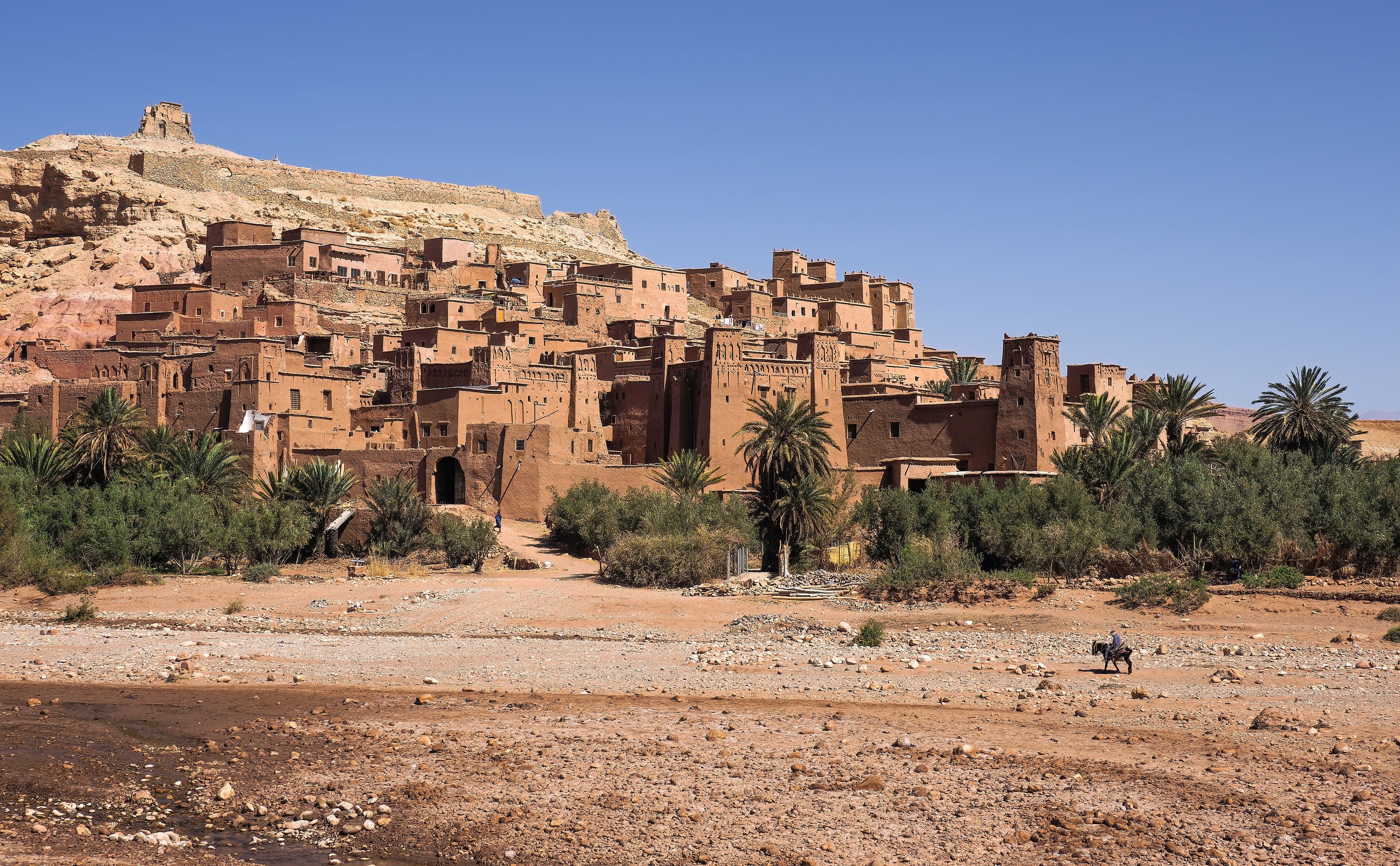
Aït Benhaddou 30 km from Ouarzazate (free entry, optional local guide 80-100 MAD / €8-10): the UNESCO ochre earthen ksar — cross the river on stepping stones, climb to the collective granary at the top. View over the Drâa plain. Arrive late afternoon for warm light on the kasbahs. Night at Auberge Chez Momo (350-500 MAD / €35-50) or in a guesthouse at the foot of the ksar.
Tips- · Todra Gorge: if you have 1h of slack, the detour is truly worth it — 300 m cliffs enclose a cool river and it's one of Morocco's finest via ferrata sites (climbing optional).
- · Car rental for this leg: budget 350-500 MAD / day (€35-50) + fuel. Roads are manageable in a standard car except secondary tracks in the gorges.
- 11Day 11
Aït Benhaddou → Marrakech via the Tizi n'Tichka pass
Return to Marrakech via national road N9 over the Tizi n'Tichka pass (2,260 m elevation) — one of Morocco's most spectacular roads. On the far side of the pass, the High Atlas asserts its scale: switchbacks, Berber villages clinging to the slopes, breathtaking panoramas. Total distance Aït Benhaddou → Marrakech: 200 km, 3h30 driving.
Possible stops along the way: Telouet (15 km off the main road, ruins of the Glaoui kasbah, entry 20 MAD / €2, striking post-colonial atmosphere of abandonment), Berber pottery villages on the northern slopes of the Tichka.
Arrive in Marrakech early afternoon. Check into a medina riad: Riad Yasmine (from 600 MAD / €60), Riad BE (700-900 MAD / €70-90), or Riad Dar One for a more intimate experience. Afternoon, first plunge into the souks — spice souk (Rahba Kedima), babouche souk, carpet souk. Dinner on Jemaa el-Fna square (food stalls open at 7pm: brochettes, harira, snails, freshly squeezed orange juice).
Tips- · Tizi n'Tichka pass: the road is passable year-round except in snowfall events in January-February (check with the riad the evening before). If snow closes the pass, the alternative route is via Taroudant.
- · Arriving in Marrakech: don't drive into the medina — drop bags at Bab Doukkala or Bab el-Jedid then walk to the riad (10-20 min depending on location) or take a calèche (80-100 MAD / €8-10).
- 12Day 12
Marrakech — Jemaa el-Fna, souks, Majorelle Gardens and hammam
Full day in the imperial city. Start early (before 9am) in the medina souks: spice souk (Rahba Kedima), tanners' souk, babouche souk, carpet souk. A certified neighbourhood guide (200-300 MAD / €20-30 for a half-day, booked via the riad) is helpful but not essential — never accept an impromptu street guide.
Bahia Palace (70 MAD / €7, open 9am-5pm) mid-morning: labyrinthine courtyards, zellige tiles and arabesque woodwork. Lunch at Nomad (rooftop terrace with medina view, modern Moroccan cuisine, main dish 130-170 MAD / €13-17, strongly recommended to book) or at Le Foundouk restaurant (120-180 MAD / €12-18).
Afternoon: taxi (20 MAD / €2) to the Majorelle Gardens (entry 150 MAD / €15, Berber museum included or optional). Arrive at 3-4pm for golden light and thinner crowds. Then a traditional hammam in the medina (50-80 MAD / €5-8 for a neighbourhood hammam, or 200-350 MAD / €20-35 in a para-hotel hammam like Hammam de la Rose). Dinner at Café de France or at Terrasse des Épices (rooftop view, pigeon pastilla 120 MAD / €12).
Tips- · Majorelle Gardens: book online at jardinmajorelle.com to skip the queue — same price (150 MAD / €15) but no wait, essential in April-May and October.
- · Hammam in the medina: Hammam Ben Youssef (public, mixed with separate time slots, 15 MAD / €1.50) is an authentic experience — bring your own towel and check the women/men schedule in advance.
- 13Day 13
Marrakech → Essaouira — Atlantic coast
CTM or Supratours bus Marrakech → Essaouira: 3h journey, 90-120 MAD / €9-12, departures at 8am, 9:30am and noon. Book the evening before at the CTM counter at Bab Doukkala or on ctm.ma. The road follows the Atlantic hinterland — argan trees with goats perched in the branches (yes, this is real and unique to this region of Morocco).
Arrive in Essaouira early or mid-afternoon. A white and blue town built by King Mohammed III in the 18th century, blending Portuguese architecture with Moroccan medina. The wind blows almost constantly — earning it the nickname 'Wind City of Africa'.
Check into a medina riad: Riad Chbanate (from 600 MAD / €60), Riad le Jardin des Douars (700-900 MAD / €70-90), or Dar Liouba for a more intimate atmosphere. First stroll around Place Moulay Hassan and the Skala du Port ramparts (Portuguese cannons, view over the Atlantic). Fresh fish dinner at Essaouira port: grilled sardines (30-40 MAD / €3-4), calamari skewers (40-60 MAD / €4-6) at one of the portside restaurants.
Tips- · Bus Marrakech → Essaouira: book the evening before at the CTM counter at Bab Doukkala — in high season (April-May, October), morning departures often sell out on the day.
- · Goats in argan trees: the spectacle is best seen between Marrakech and Essaouira on the R207, but note that some farmers have learned to place them for paid photos — spontaneous natural goats are rarer but do exist.
- 14Day 14
Essaouira morning — port, ramparts → return to Marrakech → departure
Gentle last morning in Essaouira. Slow rise, coffee on the riad terrace, a stop at the fishing port for the trawler haul (7-8am, fish auction, seagulls everywhere). Final shopping at Essaouira's spice souk: saffron threads (40-60 MAD / €4-6 per gram, far cheaper than in Europe), argan oil from a women's cooperative (Coopérative Marjana or Amal, 150-200 MAD / €15-20 for a 100ml bottle), ras el-hanout, cumin.
CTM or Supratours bus Essaouira → Marrakech: departure at 7am, 8:30am or 10am depending on the company, 3h journey, 90-120 MAD / €9-12. Book the evening before at the counter (Place de l'Horloge) or on ctm.ma. Arrive at Marrakech bus station (Bab Doukkala).
If the flight is in the evening (6pm or later): final lunch in the medina at Terrasse des Épices (pastilla, tagine, rooftop view), or a last souk sweep for forgotten purchases. Taxi to Ménara airport: 70-80 MAD / €7-8, allow 30-45 min depending on traffic. Golden rule: pack your bags the night before — medina alleyways and luggage porters take 15-20 min to reach the taxi square.
Tips- · Essaouira saffron: buy from a trusted medina grocer (ask your riad) not from shops facing the ramparts — prices are 2-3 times lower for the same quality.
- · Final taxi to Marrakech airport: from Bab Doukkala, expect 70-80 MAD (€7-8) in a petit taxi — if arriving by CTM bus, taxis wait just outside the bus station exit.
Other durations
Frequently asked questions
Do French (and European) nationals need a visa for Morocco?+
Rental car or public transport for this 14-day circuit?+
Travelling during Ramadan: what adjustments should I make?+
Safety in Morocco: are there areas to avoid?+
What is the best month for this circuit depending on the climate?+
Our verdict
This 14-day Morocco circuit is the grand tour for travellers who refuse to choose: it embraces the imperial north (Rabat, Fes, Chefchaouen), the Saharan depth of the south (Merzouga, Aït Benhaddou), the power of the imperial cities (Marrakech) and the Atlantic softness of Essaouira in one coherent journey. Compared to the 10-day circuit, the difference is not merely quantitative — Chefchaouen and Rabat bring an entirely different register, more European, more Andalusian, that makes you understand how many faces Morocco has. The logistics are demanding (one internal flight, several transport modes), but each travel day opens onto a new landscape that justifies the effort.
The key piece of advice: don't compress anything. This circuit is calibrated at the minimum for 14 days — attempting to rush it means turning a sensory experience into a checklist. Three stages to protect absolutely: the sunrise over the Merzouga dunes (Day 9), the early-morning solo wander through Chefchaouen's blue alleyways before 8am (Day 7), and the first evening on Jemaa el-Fna square in Marrakech (Day 11). These are the three moments that stay with you long after you return home.
Read also
- When to visit Morocco — Month-by-month climate and best seasons by region.
- Morocco budget — How much to plan per day depending on travel style and cities.
- Moroccan desert: guide to Erg Chebbi dunes — Bivouac, sunrise, dromedaries — everything about the desert experience.
Written by La rédaction · Updated 5/29/2026
Morocco