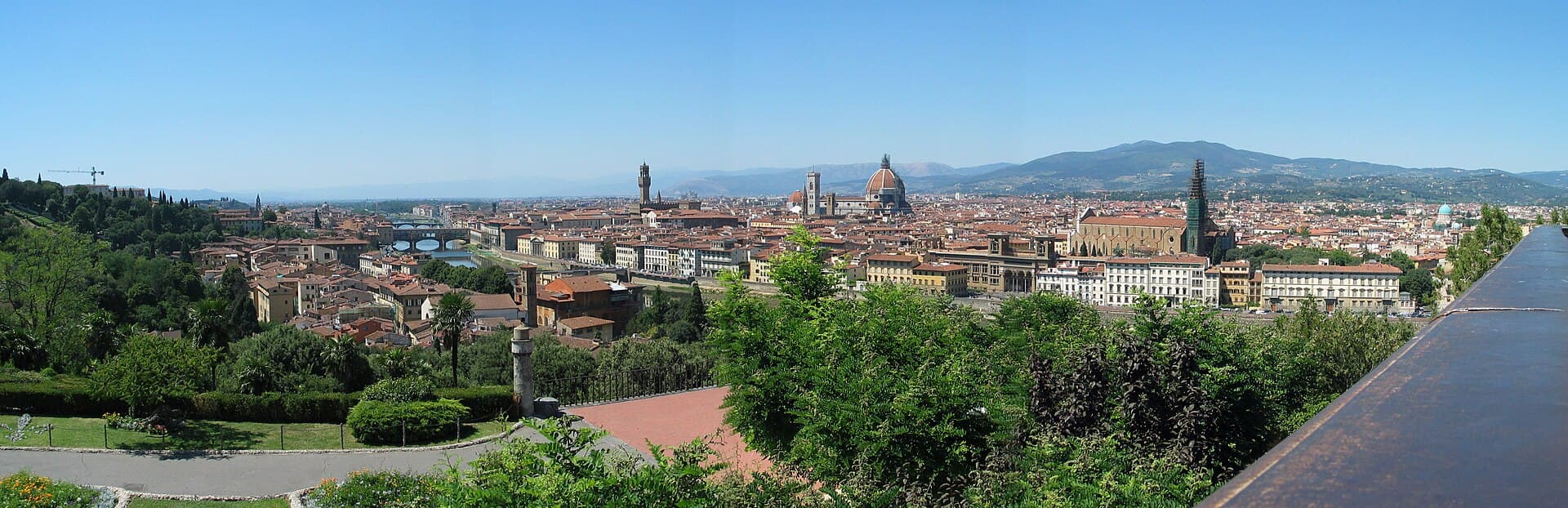
Florence holds an artistic density few cities on earth can match. The itinerary builds around a handful of headline sights, with neighbourhoods and spontaneous detours filling in the rest.
The Uffizi Gallery is the absolute priority. Founded by the Medici in the sixteenth century, it brings together the world's greatest collection of Renaissance painting: Botticelli's Primavera and Birth of Venus (rooms 10-14), Leonardo da Vinci's Annunciation, Michelangelo's Doni Tondo, Piero della Francesca's portraits of Federico da Montefeltro. Allow at least two and a half hours for a calm visit, starting with the fourteenth-century rooms (Giotto, Cimabue) to follow the chronological evolution. The Accademia houses Michelangelo's David (1504), a 5.17-metre sculpture of staggering anatomical precision — expect a queue even with a reservation. The hall of the Prisoners (Michelangelo's unfinished sculptures) is a philosophically powerful companion piece you should not skip.
The Duomo (Santa Maria del Fiore cathedral) dominates the city under the dome that Brunelleschi designed between 1420 and 1436 — an engineering feat with no equivalent anywhere in Europe at the time. The climb up 463 steps is a physical and visual experience you'll remember for years: a unique panorama over Florence's terracotta roofs and the Tuscan hills beyond. The Palazzo Pitti and Boboli Gardens form a museum within a museum — six separate galleries including the Palatine (Raphael, Titian) and the Museo degli Argenti (Medici treasures).
Beyond the museums, Florence is also a market city. The Mercato Centrale (covered, with a food court on the upper level) is the easiest gastronomic pause at the heart of the San Lorenzo market. The Mercato delle Pulci (flea market) in Piazza dei Ciompi rewards a slow browse. The outdoor stalls of Sant'Ambrogio sell the best fresh produce in the city. A first-light walk across the Ponte Vecchio — well before the tour groups arrive — remains a defining experience despite its cliché status. Climb up to San Miniato al Monte at sunset for the kind of city view that justifies the whole trip on its own.
Read also
- Central Italy: Rome, Florence and Tuscany — The region that holds the two great capitals of Western art.
- Rome, the Eternal City — Ninety minutes by Frecciarossa from Florence: 28 centuries of history in a single city.
- Italy — Complete country guide: entry rules, budget, regions and when to visit.
- Venice, La Serenissima — Two hours by train from Florence: canals, Gothic palaces and Venetian life.