Region
East Fjords
Iceland at its most authentic and least touristy: 120 km of deeply cut fjords, colourful fishing villages and the country's only wild reindeer population.
Iceland's East Fjords are the wildest and least-visited stretch of the Ring Road — many short-trip travellers skip them entirely, which paradoxically makes them one of the country's most authentic regions. Count approximately 120 km of coast deeply cut by a succession of fjords (Berufjörður, Stöðvarfjörður, Faskrúðsfjörður, Reyðarfjörður, Eskifjörður, Seyðisfjörður), each sheltering a small fishing village (200-1,500 inhabitants) with colourful corrugated-iron houses, set at the foot of abrupt mountains 600 to 1,000 m high.
Egilsstaðir (2,500 inhabitants), the regional capital and only town worthy of the name east of Vatnajökull, is the logistical hub: domestic airport (Reykjavik-Egilsstaðir flight in 1 h), Bonus supermarkets, car hire agencies, mid-range hotels and decent restaurants. The town has no particular charm but serves as an efficient base for exploring the region. 10 minutes to the south, the Lagarfljót lake (53 km long, 112 m deep) is said by legend to house Lagarfljótsormur, a water creature comparable to the Loch Ness monster — an official video from 2012 revived the myth.
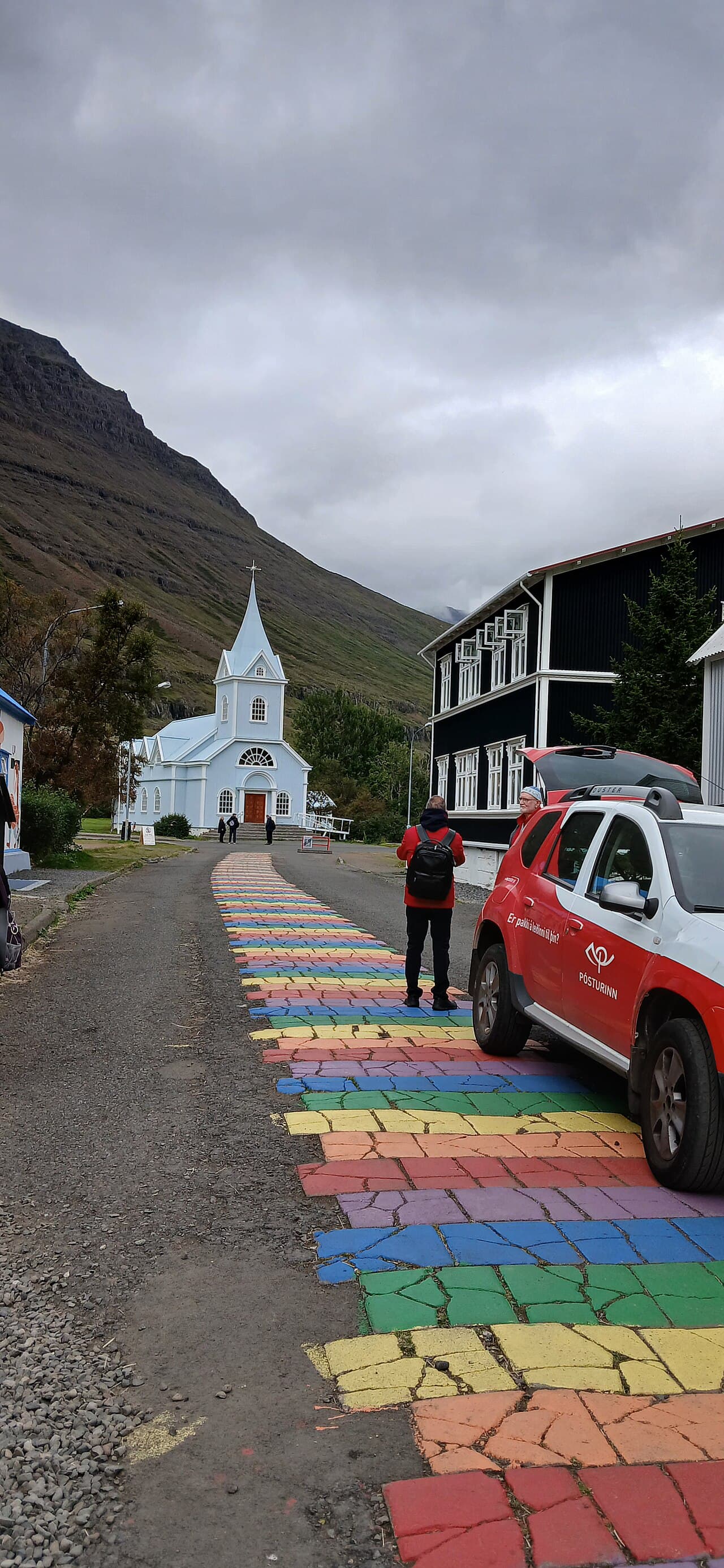
Seyðisfjörður (700 inhabitants), 30 minutes from Egilsstaðir via Route 93 (snowy 620 m pass), is the jewel of the region: a multicoloured village of Norwegian inspiration set at the head of a deep fjord, with its iconic sky-blue church at the end of the rainbow street paved in 2017 to celebrate the LGBTQ+ community. It is also the terminus of the Smyril Line ferry from Denmark and the Faroe Islands. The village hosts in July the Lunga Festival of alternative art and music that draws artists and hippies from around the world.
The fjord villages succeed each other on Route 1 between Höfn (south) and Egilsstaðir (north): Djúpivogur (lively port, Eggin í Gleðivík sculpted eggs workshop), Breiðdalsvík, Stöðvarfjörður (Petra's Stones rock and mineral museum), Fáskrúðsfjörður (Breton French sailors' cemetery, historical link with cod fishing), Reyðarfjörður (1940-1945 British occupation museum). Count 4-5 hours of driving between Höfn and Egilsstaðir with stops, compared to 3 h direct.
The wildlife is one of the East Fjords' unique assets. This is the only region of Iceland where wild reindeer live — about 6,000 individuals introduced from Norway in the 18th century that now populate the inland valleys. They are regularly observed from Route 1, especially in winter when they descend into the valleys. The Borgarfjörður Eystri peninsula (Route 94, accessible mid-May to September) hosts one of the largest puffin colonies in the country. Whale tours from Fáskrúðsfjörður or Eskifjörður offer a less-frequented alternative to Húsavík.
Explore East Fjords
Situation
Où se situe East Fjords ?
Ouvrir la carte en grand sur OpenStreetMap →Frequently asked questions
How many days do you need to visit the East Fjords?+
Is taking the domestic flight to Egilsstaðir worthwhile?+
Is the Smyril Line ferry from the Faroes/Denmark worth it?+
Can you see wild reindeer in the East Fjords?+
What is Stuðlagil and how do you access it?+
Are there whales in the East Fjords?+
Which East Fjords village really deserves an overnight?+
Our verdict
The East Fjords are the reward for travellers on a complete Ring Road road trip: the authenticity of an Iceland before mass tourism, spectacular landscapes and a human rarity that turns each encounter into a special moment. Plan a minimum of 2 days on site (1 night at Egilsstaðir, 1 night at Seyðisfjörður) within a 10-14 day road trip. Our tip: combine the fjords with an excursion to the Borgarfjörður Eystri peninsula (Route 94, accessible mid-June to September) to observe the most accessible puffins in Iceland, and a stop at Stuðlagil (blue basalt-column canyon, 1 h north of Egilsstaðir) which has become one of the country's most photogenic sites since 2017.