A visit to Aswan organises over two or three full days, deliberately at a slower pace than Luxor.
The Temple of Isis at Philae is the absolute must-see. Saved from Lake Nasser's waters in the 1970s by a UNESCO operation that dismantled and rebuilt stone by stone the entire complex on neighbouring Agilkia Island, the temple (built between the 4th century BC and the 2nd century AD) is one of the last pagan sanctuaries to have ceased activity — in 535 AD, more than two centuries after Theodosius's edict banning pagan worship. Access by boat from the Shellal landing (10-minute crossing). Sound and light show in the evening, rotating languages.
Elephantine Island, in the heart of the Nile facing the Aswan Corniche, is the other essential site. Reached by felucca in 5 minutes (€1-2), it holds three living Nubian villages (Siou, Koti, Gharb Aswan) where houses are painted in bright colours — deep blue, ochre, white — and where residents readily welcome visitors over a glass of karkadé tea. The southern tip holds the remains of the ancient city of Yebou (capital of the first nome of Upper Egypt under the Old Kingdom), the Ptolemaic Temple of Khnum, the ancient nilometer and the Aswan Museum. Plan a half-day minimum, with late afternoon for sunset from the northern tip.
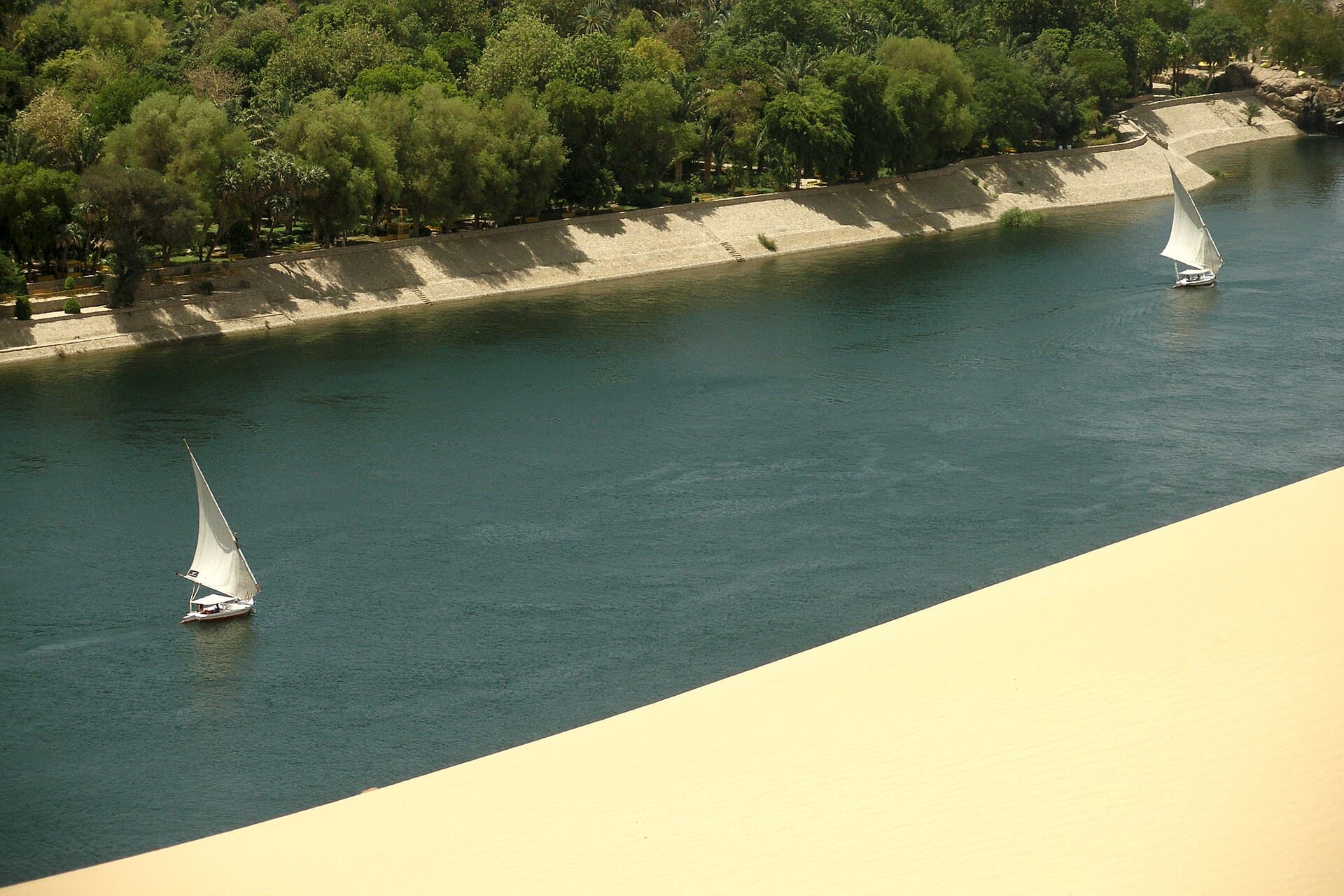
Feluccas on the Nile at sunset are one of the great experiences of Egyptian travel. Count €15-25 for a 1.5-2 hour cruise on the cataract, ideally to the Kitchener Island botanical garden (7 hectares of exotic plants planted in the late 19th century by Horatio Kitchener) and back along the west bank with a stop at the Aga Khan III mausoleum, perched on the cliff. Several felucca owners also offer overnight stays onboard (sleep on deck, dinner over wood fire) — an experience to live at least once for travellers open to simple comfort.
Aswan's spice souk is one of the most authentic in Egypt: cardamom, dried karkadé, henna, incense, woven Nubian baskets, silver jewellery. Less touristy than Khan el-Khalili in Cairo, it keeps a real daily activity. Go in late afternoon when Nubian shopkeepers sip their tea and golden light falls on the stalls.
The High Dam (8 km south) is an impressive industrial monument — 3,600 m long, 111 m high, holding back Lake Nasser's 500 km — which transformed the economy of the entire region from 1970 (at the cost of submerging hundreds of Nubian villages and several ancient sites, including Abu Simbel saved in extremis). Nearby, the Unfinished Obelisk in the ancient granite quarries allows you to understand how the Egyptians cut these 42-metre monoliths (over 1,000 tonnes) directly from the rock — it remained in place after a crack appeared during cutting.
Finally, for enthusiasts, a day excursion to Abu Simbel (280 km south, see dedicated guide) is one of the most striking moments of any Egyptian trip. Very early departure (3-5 am depending on format), return mid-afternoon. Domestic flight (45 min) or bus/4WD (3h30 by road).
Read also
- Abu Simbel, Ramesses II's temples — 280 km to the south: the rock-cut masterpiece saved by UNESCO.
- Luxor, capital of the pharaohs — 220 km north: Karnak, Valley of the Kings and the heart of the New Kingdom.
- Egypt — Complete country guide: entry rules, budget, when to visit, regions.