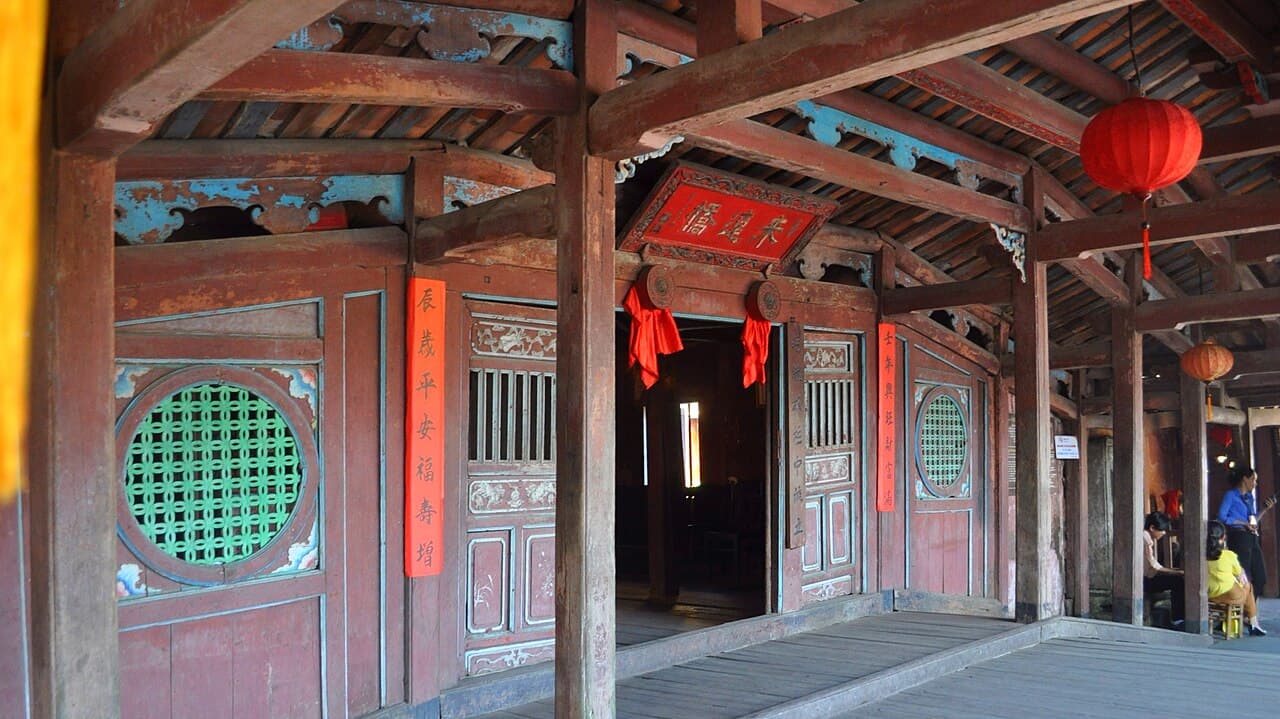
Exploring Hoi An necessarily begins in the ancient town (Hoi An Ancient Town), whose access is managed by a combined entry ticket (120,000 VND) granting entry to five chosen sites from the community halls, merchant houses and temples. The city's absolute symbol is the Japanese Covered Bridge (Cau Nhat Ban), built in 1593 by the Japanese merchant community: a covered footbridge over the Bach Dang canal, decorated with statues of dogs and monkeys at each end — the last remnant of Hoi An's ancient Japanese community.
The merchant houses repay a detailed visit: Tan Ky house (200 years of family history, hybrid Sino-Vietnamese architecture), Phung Hung house (two centuries of international commerce, canal view from the balcony), and the Chinese community halls — Phuc Kien (Fujian), Trieu Chau (Chaozhou), Quang Dong (Canton) — testify to the migration waves that shaped the city. The Tran Family Chapel (mandarin family, 17th century) is one of the best-preserved examples of Vietnamese aristocratic residential architecture.
Hoi An is also Vietnam's capital of custom tailoring. Hundreds of workshops, from family stalls to established local fashion houses, offer dresses, suits, blazers and traditional garments (ao dai) in 24 to 48 hours. Well-regarded addresses include Yaly Couture, A Dong Silk and Kimmy Fashion — bring precise photos, choose your fabric, and allow two fittings. Hoi An Central Market (Cho Hoi An) is the other living economic heart of the city: silks, handcrafted lanterns, spices, tropical fruit and the finest morning bowls of cao lau.
Four kilometres east, An Bang Beach is the connoisseur's choice: quieter than Cua Dai, with good seafood restaurants on the sand (The Deck, Soul Kitchen), sun loungers to rent for 50,000 VND and water at 25-29 °C in high season. Ideal for a half-day of decompression between temple visits.
The essential excursion from Hoi An is the My Son ruins (40 km west, 45 minutes): a complex of Cham Hindu temples from the 4th-12th centuries, UNESCO-listed, nestled in a valley surrounded by wooded hills. The red-brick tower architecture, dedicated to the god Shiva, recalls Angkor Wat on a more intimate scale. Leave before 8 am to avoid the heat and tour groups. The city of Hue (former imperial capital, 120 km north via the spectacular Hai Van Pass coastal road) is accessible as a long day trip or overnight for history enthusiasts of the Nguyen dynasty.
Read also
- Central Vietnam — the complete region — Hoi An, Hue, Da Nang and the My Son ruins: itineraries and highlights of the centre.
- Hue, the imperial citadel — The former capital of the Nguyen emperors, 1 hour from Hoi An via the Hai Van Pass road.
- Vietnam — complete country guide — Visas, budget, regions and best time to visit Vietnam.
- Hanoi, the northern capital — Millennial Old Quarter, dawn pho and the gateway to Ha Long Bay.