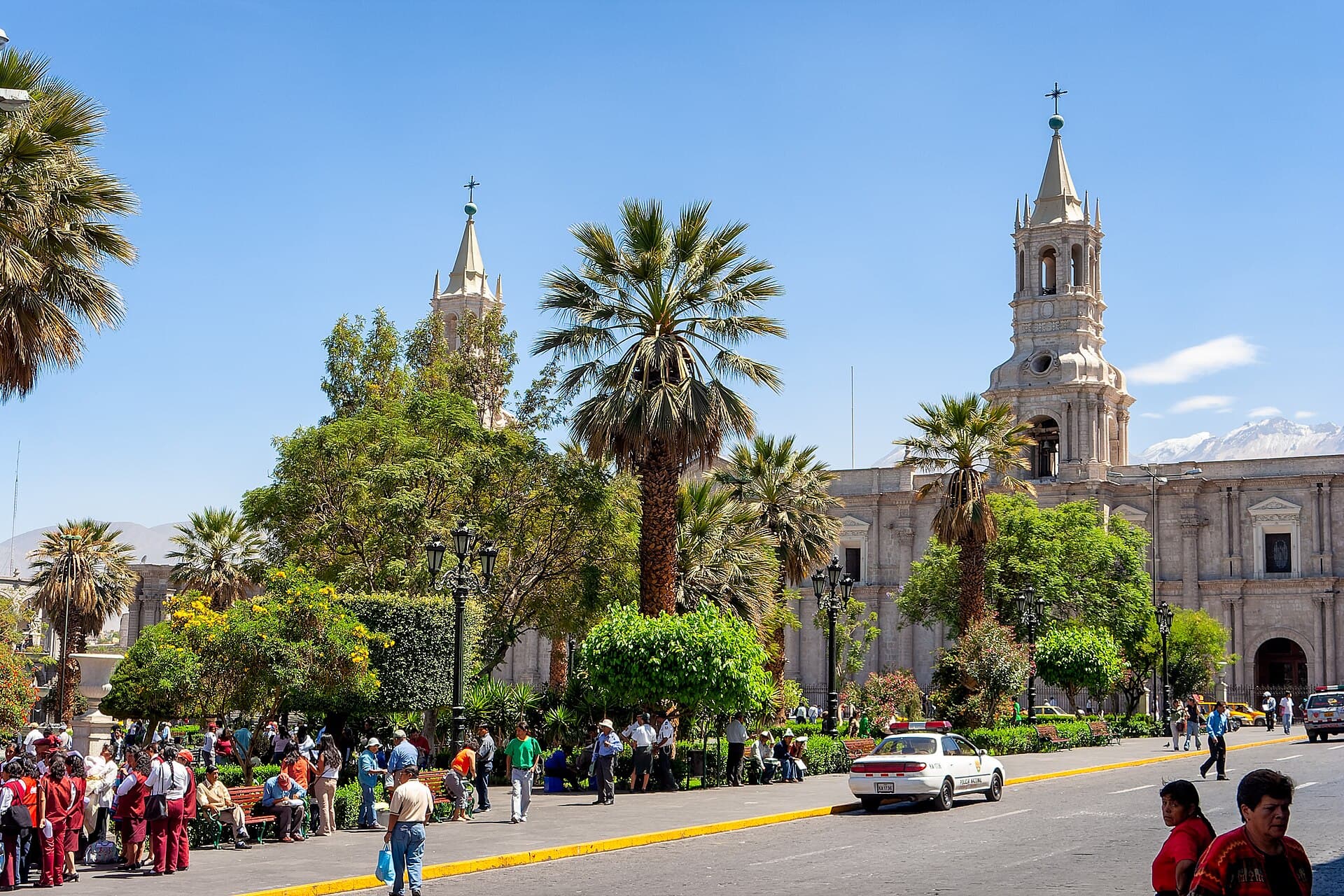
Arequipa and Lake Titicaca is Peru's major southern Andean region, stretching from the volcanic foothills of Misti (5,822 m) to the sacred shores of Lake Titicaca (3,812 m), via the Colca Canyon (1,500 m deep). This region perfectly complements the Cusco cultural trip with spectacular landscapes, exceptional baroque colonial architecture (Arequipa UNESCO 2000) and powerful pre-Inca heritage (Collagua cultures at Colca, Uros and Taquile on Titicaca).
The region subdivides into three complementary hubs with distinct personalities. Arequipa (the White City, 2,335 m, 1 million inhabitants) is Peru's second city after Lima and one of the most beautiful in Latin America. Founded in 1540 on pre-Inca structures, it developed in the 16th-17th centuries a unique colonial architecture entirely built in sillar — translucent white volcanic stone extracted from Misti lava flows — giving the city its nickname and luminous atmosphere. The colonial historic centre is UNESCO-listed since 2000. Emblematic monuments: Santa Catalina monastery (5 hectares of cloistered monastery at the city heart, founded 1579, Dominicans), baroque cathedral (1656-1844, rebuilt several times after earthquakes), Plaza de Armas (one of Latin America's most beautiful, sillar arcades), Andean Sanctuaries museum (Juanita mummy).
The Colca Canyon (3-5h north of Arequipa by road) is one of the most spectacular Andean landscapes — 1,500 m deep, i.e. twice as deep as the Grand Canyon of Colorado. The canyon is framed by traditional villages (Chivay, Yanque, Maca, Pinchollo, Cabanaconde) where Quechua-Collagua culture remains alive — embroidered traditional costumes worn daily, still-cultivated pre-Inca agricultural terraces, vicuña, llama and alpaca breeding in pampa zones at 4,500 m. The flagship attraction: Andean condor observation at the Cruz del Condor Mirador — each morning between 8:30am and 10:30am, condors (wingspan up to 3 m, one of the world's largest flying birds, vulnerable species) rise in canyon updrafts, creating a striking spectacle. Several formulas: classic 2-day/1-night excursion (€80-150/person from Arequipa, transport + night Chivay + Cruz del Condor + La Calera hot springs + return), 2-3 day trek in the canyon for sports lovers (descent to Sangalle, canyon bottom oasis at 2,200 m).
Puno and Lake Titicaca (3,812 m, 4-6h drive from Arequipa via Juliaca) constitute the region's lacustrine and pre-Inca dimension. Puno (130,000 inhabitants) is a base city without great charm but remains the essential gateway to the sacred lake of the Incas — according to Inca mythology, Manco Cápac and Mama Ocllo, founders of the empire, emerged from the lake's waters sent by the god Inti to found Cusco. The lake covers 8,372 km² (1.3 times Corsica), 281 m maximum depth, world's highest navigable lake, shared between Peru (60%) and Bolivia (40%). Classic excursions: floating Uros Islands (totora reed constructions, Uros community living literally on water since pre-Inca era, half-day €30-50), Taquile Island (traditional Quechua island, textiles inscribed UNESCO intangible heritage 2008, homestay possible, full day €50-80). Amantani Island (2-day/1-night homestay option with Quechua family) for more immersive experience.
Read also
- Arequipa — The White City at the foot of Misti, UNESCO 2000, Santa Catalina monastery.
- Lake Titicaca — The world's highest navigable lake at 3,812 m, floating Uros Islands and Taquile.
- Peru — Complete country guide: visa, currency, regions, best time to visit.
- Cusco and Machu Picchu — The absolute must-see — to combine with Arequipa-Colca-Titicaca for 14-18 days.