Africa
Morocco
UNESCO medinas, Atlas peaks and Sahara dunes — total escape just three hours from Europe.
- Capital
- Rabat
- Currency
- Dirham marocain (MAD)
- Languages
- Arabe, Amazighe (berbère), Français
- Budget
- Mid-range — from around €55/day/person
Morocco at a glance
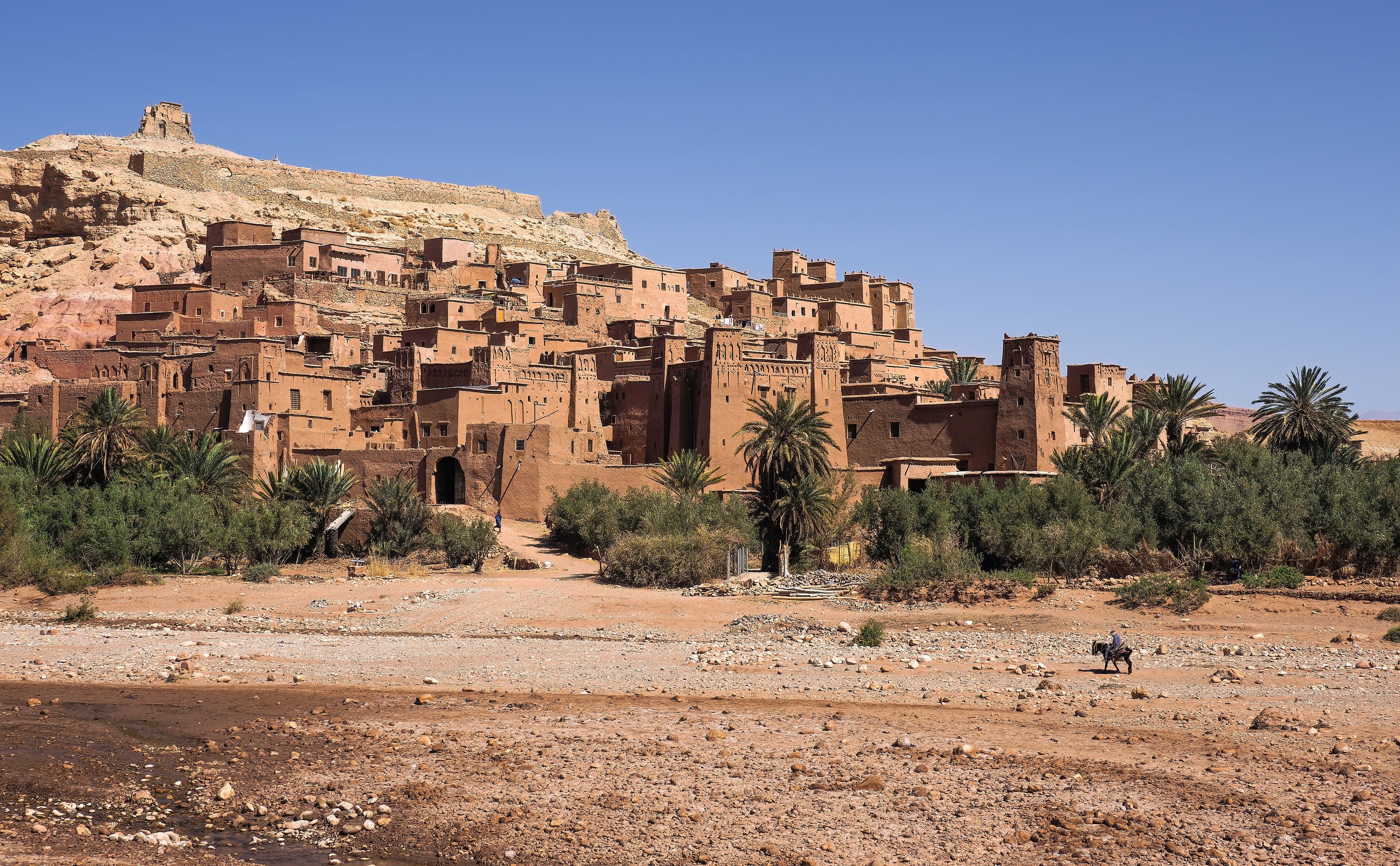
Morocco packs a rare diversity into a single country: centuries-old UNESCO medinas, the snow-capped peaks of the High Atlas, an Atlantic coast swept by trade winds and the first dunes of the Sahara. Four imperial cities — Marrakech, Fes, Meknes and Rabat — chart a thousand years of history, while the kingdom's hospitality, cuisine and craftsmanship have built its reputation across the Mediterranean. A short hop from London or Paris, this is one of the most immersive escapes Europe-bound travellers can dream up: in a single week you can lose yourself in the souks of the Marrakech medina, sleep under the stars in a Saharan camp and trek beneath the 4,000-metre summits of the Toubkal massif. Few destinations cram so much variety into a country smaller than France.
What makes Morocco unique is the layering. Berber, Arab, Andalusian, sub-Saharan and Jewish influences have been weaving the same fabric for centuries, and the result is everywhere — in the architecture of the medersa, in the rhythms of Gnawa music, in the tagines simmering in clay pots and in the daily ritual of mint tea. The country has invested heavily in its tourist infrastructure (high-speed trains, modern airports, refined riads) without smoothing away the rough authenticity that makes it so compelling. For a first trip, focus on the imperial cities and the High Atlas; for a deeper dive, head out to the Atlantic coast, the deep south or the Rif mountains. Solo travellers, couples and families all find a comfortable rhythm here, and the practical basics — visa-free for most Western passports, a closed currency easy to handle on arrival, English steadily replacing French as the tourism lingua franca — make logistics straightforward.
Whichever route you take, Morocco delivers some of the best value for money in the wider Mediterranean basin: a boutique riad with a courtyard fountain and a roof terrace overlooking the medina goes for €60-90 a night, a tagine in a back-street gargote costs less than a London pint, and a guided day-trek into the Atlas with lunch in a Berber home rarely tops €40. Few countries offer this much travel for this little money so close to home.
What we love
- ✅A genuinely immersive escape just three hours from Europe
- ✅Medinas and sites listed by UNESCO
- ✅Generous cuisine and exceptional craftsmanship
- ✅Affordable budget outside the luxury bracket
- ✅Varied landscapes: desert, ocean, mountains
What to know
- ❌Persistent touting in the busiest medinas
- ❌Extreme heat inland in summer
- ❌Chaotic traffic in the big cities
- ❌Heavy crowds on the headline sites
Explore Morocco
Situation
Où se situe Morocco ?
Ouvrir la carte en grand sur OpenStreetMap →Frequently asked questions
When is the best time to visit Morocco?+
Do I need a visa for Morocco?+
Is Morocco safe for solo female travellers?+
How many days do I need in Morocco?+
What currency is used in Morocco?+
Is Morocco a safe country to visit?+
What should I wear in Morocco?+
Our verdict
Morocco remains one of the most complete and accessible destinations from Europe, packing medinas, mountains, desert and ocean into a single itinerary. Its strengths lie in a deep heritage — nine UNESCO sites, centuries of imperial history and a thousand-year-old craft tradition — alongside one of the most sophisticated cuisines in the Mediterranean and excellent value for money outside the luxury bracket. The hospitality of riads, the rituals of the hammam and the easy 3-hour flight from London or Paris make Morocco one of the rare destinations that genuinely feels like an escape while remaining logistically straightforward. Few countries combine such cultural depth with such modern travel infrastructure — high-speed trains, low-cost flights, English-speaking guides — and at this kind of price point.
The other side of the coin: aggressive touts in the busiest medinas, summer heat that crosses 40°C in Marrakech and Fes, and crowds on the headline sights in shoulder season. Tap water is best avoided and the medina maze can be disorienting on day one. None of this is a deal-breaker — a guide for the first day in the medina, a spring or autumn departure and a willingness to bargain politely will smooth almost every rough edge. For a first trip to Morocco, pair an imperial city with an Atlas or Atlantic escape; for a second visit, head south into the Sahara or north into the Rif. Whichever route you take, you'll leave already plotting the return.

Expert on Morocco · 1 contributions