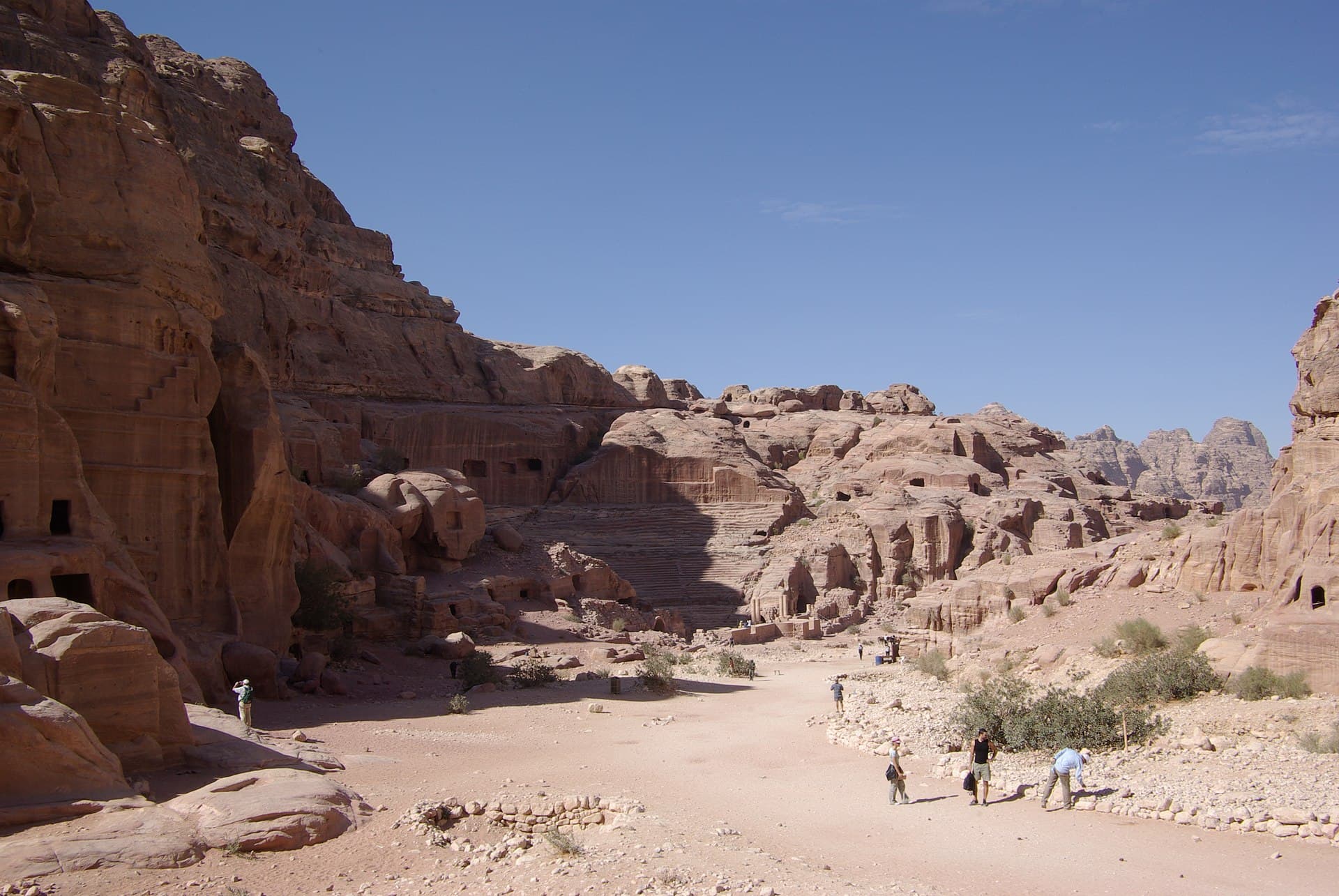
A complete visit to Petra unfolds over two full days minimum, ideally three for enthusiasts.
The first day covers the classic itinerary. Start at opening (6am in summer, 6:30am in winter) from the ticket office. Walk 800 metres to the entrance of the Siq — passing the first cubic stone blocks (the Djinn Blocks) and the Obelisk Tomb (Nabataean façade mixing Egyptian influences). Enter the Siq — natural canyon 1.2 km long, sometimes only 3 m wide, walls up to 80 m high — and walk 20-25 minutes observing the water channels still visible on the walls (Nabataean hydraulic system of remarkable sophistication). At the final turn of the canyon, you discover the Treasury (Khazneh): 40 metres high, six Corinthian columns, broken pediment, summit tholos, funerary urn. Take time to observe the sculptural details (Tyche, Castor and Pollux, statues of the goddess Allat) and the degradation from water runoff over the centuries.
Continue to the Roman theatre (4,000 seats, carved into the rock, probably built by the Nabataeans and enlarged by the Romans after the 106 conquest), the Royal Tombs (Urn Tomb, Silk Tomb with hallucinatory colours, Corinthian Tomb, Palace Tomb), and the Roman colonnaded street (remains of the great 2nd-century commercial artery). Midway, have lunch at the Basin Restaurant or picnic near the Al-Khubtha temple. If you still have energy, climb to the High Places of Sacrifice (Al-Madbah) by a 600-step staircase — exceptional panorama over the site and the Nabataean sacrificial altar at the summit.
The second day is dedicated to the Monastery (Ad Deir) and off-the-beaten-track hikes. Start early (7-8am) as the ascent takes time. From the centre of the site (Qasr al-Bint), follow the 800-step path cut into the rock for 45 minutes to 1h15. The Monastery, even bigger than the Treasury (47 m high), appears suddenly at the top of the plateau — late Nabataean façade, probably from the 3rd century AD, in remarkable preservation. Count 30 minutes to 1 hour on site: climb the opposite rocks for the classic photograph, then climb to the two panoramic viewpoints (signposted "View 1" and "View 2") for exceptional views over Wadi Araba and the Edom mountains. Descent in 30-45 minutes.
An optional third day lets you explore Little Petra (Siq al-Barid) 9 km north (free entry, 1-2h on site) and the High Places of Sacrifice (Al-Madbah) if you didn't on day one. Hiking enthusiasts can add Jebel Haroun (Mount Aaron, Muslim mausoleum at the summit, 4-5h round trip from the site) or the Crest trail (Petra Through the Back Door, access from the north of the site).
Petra by Night (Monday, Wednesday, Thursday, 8:30-10:30pm, 17 JOD) is an experience in itself: walk through the Siq lit by 1,500 candles, Bedouin musical performance in front of the lit Treasury, traditional storytelling. Unforgettable. Book the same morning at the ticket office.
Read also
- Wadi Rum, the Martian desert — 2h south: orange dunes, Martian landscapes, Bedouin bivouac under the stars.
- Aqaba, Red Sea diving — 3h south: legendary wrecks, preserved reefs, three-country border.
- Jordan — Complete country guide: entry rules, budget, when to visit, regions.
- Amman, capital on seven hills — 240 km north: Roman Citadel, ancient theatre and the hilltop cafés of Rainbow Street.