ville
Ubud
Bali's spiritual and artistic capital, where centuries-old rice terraces meet Hindu ceremonies and Southeast Asia's finest yoga scene.
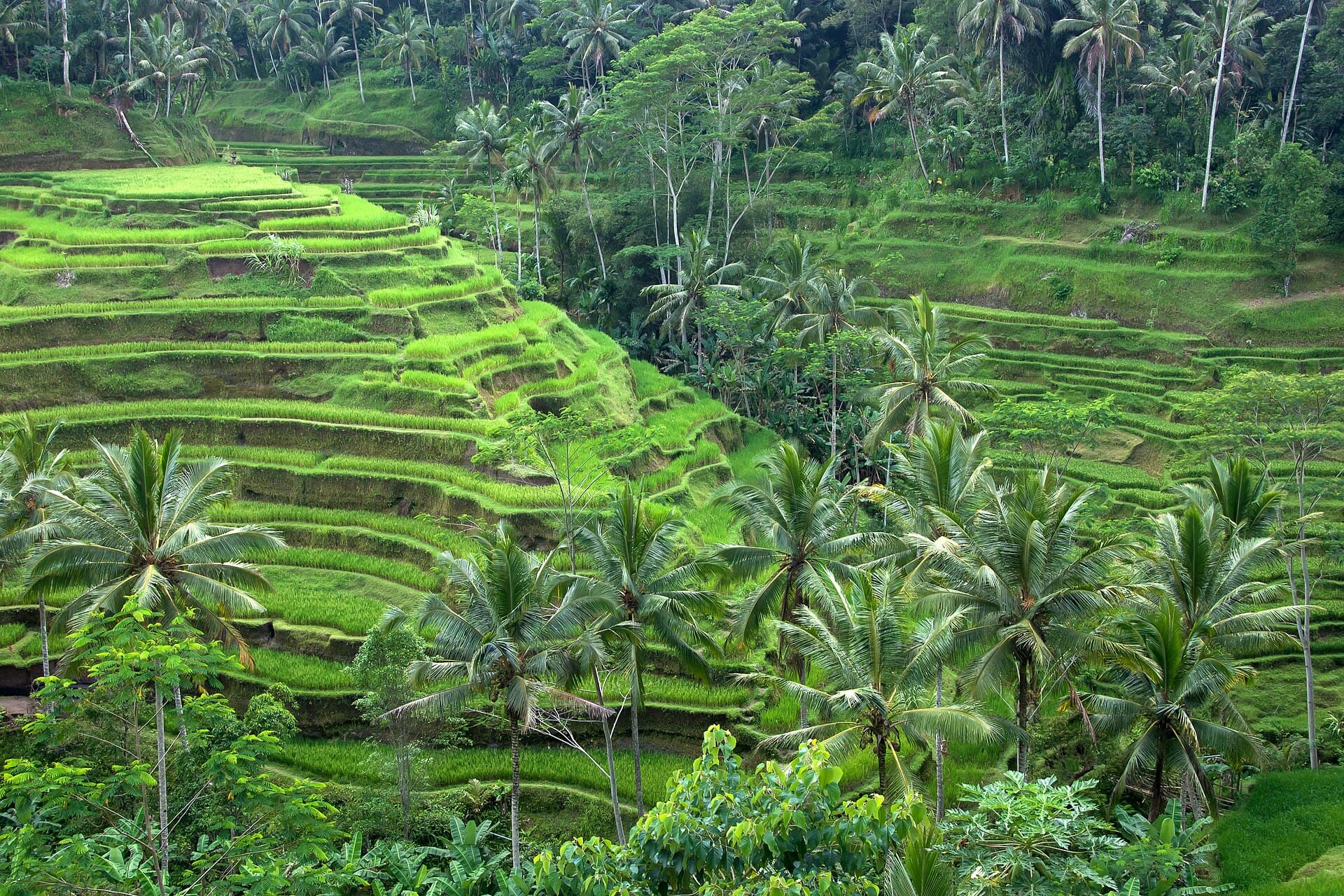
Ubud is the cultural capital of Bali, set 500 metres above sea level in the green hills of the central island, 25 km north of Denpasar. This small town of 30,000 holds the most iconic Balinese landscapes in a tight radius: the rice terraces of Tegalalang carved over centuries into the volcanic slopes, the Sangeh Monkey Forest, the water temples of Tirta Empul and Goa Gajah, and an artistic intensity that you feel from your first wander down Jalan Hanoman — galleries of traditional Balinese painting, woodcarving workshops, batik weavers and gamelan ensembles rehearsing in the village banjars after dark.
Ubud is also the global epicentre of Balinese yoga and wellness. The wake of the book and film 'Eat, Pray, Love' turned the town into a magnet for retreat seekers, and dozens of studios, ashrams and spas now line the main streets. The reputation sometimes attracts a slightly performative wellness crowd — but step away from central Ubud into the nearby villages of Penestanan, Peliatan or Nyuh Kuning and the town's authentic core is right there, unchanged: morning offerings on every doorstep, gamelan music drifting through the rice fields, and warungs where three generations of the same family still cook the bebek betutu that has been on the menu since the 1970s. Two or three slow mornings in Ubud — temple, market, then a long lunch — and the town reveals what makes it the spiritual heart of Bali.
What we love
- ✅Tegalalang and Jatiluwih rice terraces: the most photographed landscapes in Bali
- ✅World-class yoga and wellness scene, studios and retreats for every level
- ✅Exceptional cultural depth: temples, art galleries, nightly Balinese dance
- ✅Excellent local food, from authentic warungs to signature tasting menus
- ✅Ideal base for excursions: Mount Batur, central Bali temples, tropical forests
What to know
- ❌Central Ubud is crowded in high season: busy streets and packed sights by mid-morning
- ❌Heavy traffic on Jalan Raya Ubud — the main road is not built for pedestrians
- ❌No beach: Ubud sits inland, at least 45 minutes from the coast
- ❌Accommodation prices noticeably higher than Canggu for similar quality
Situation
Où se situe Ubud ?
Ouvrir la carte en grand sur OpenStreetMap →Frequently asked questions
How many days should you spend in Ubud?+
How do you get to Ubud from Bali airport (Denpasar)?+
When is the best time to visit Ubud?+
Ubud vs Canggu — which one should you choose?+
Can beginners practise yoga in Ubud?+
Do you need a scooter in Ubud?+
What's a realistic daily budget for Ubud?+
Is the Mount Batur sunrise hike worth doing from Ubud?+
Our verdict
Ubud is one of those destinations that stays with travellers long after they leave: the rice fields at Tegalalang at dawn, a kecak dance performance at Uluwatu cliff at dusk, a slow Balinese massage as the light fades, then dinner under the stars at a restaurant perched over the valley. The town pulls in a lot of visitors, but it still rewards the ones who get up early, walk the lanes off the main strip and let the Balinese cultural rhythm set the tone of the day. Skip the staged Instagram backdrops at Tegalalang in mid-morning and instead make your way to Jatiluwih, climb the back paths of Penestanan, or sit through a full temple ceremony at Tirta Empul. That is the Ubud that earns its reputation.
The practical recipe is straightforward. Plan three to four nights minimum to do justice to the town and its immediate surroundings; five or six if you want to add a Mount Batur sunrise hike or a day of craft villages (Celuk, Mas, Batuan). Travel in May-June or September-October to land the best combination of weather and crowd levels. Book a villa with a pool view of the valley if your budget allows — the contrast between the small-town energy on the main street and the silence of a private terrace at dawn is one of the underrated pleasures of an Ubud stay.
Réserver votre séjour
Liens partenaires — une commission peut nous être reversée, sans surcoût pour vous.
 HébergementAnnulation gratuite
Hôtels & villas en Indonésie
Villas privées de Bali, bungalows des Gili et guesthouses d'Ubud : comparez les hébergements de tout l'archipel.
ActivitéCoup de cœurTemples, volcans & plongée en Indonésie
Lever de soleil sur Borobudur, ascension de volcans, plongée aux Gili, rizières d'Ubud : les expériences phares.
VolComparateurVols vers l'Indonésie
Bali (Denpasar) et Jakarta via une escale : comparez les compagnies sur ce long-courrier d'environ 16 à 18 h.
Nearby

"Janvier est le cœur de la saison humide à Ubud : pluies quotidiennes en après-midi, mais les matins sont souvent ensoleillés pour explorer les temples et les marchés locaux."
Expert on Ubud · 1 contributions