Exploring Hanoi begins naturally in the Old Quarter (Pho Co), the network of 36 medieval streets each named after a trade — Hang Bac (silver), Hang Gai (silk), Hang Ma (votive paper). It is one of the best-preserved historic centres in Southeast Asia: two- or three-storey tube houses, colourful façades, inner courtyards, small neighbourhood pagodas slipped between two shops. Getting lost in these alleys in the early morning, before the scooters invade, is the founding experience of a Hanoi stay.
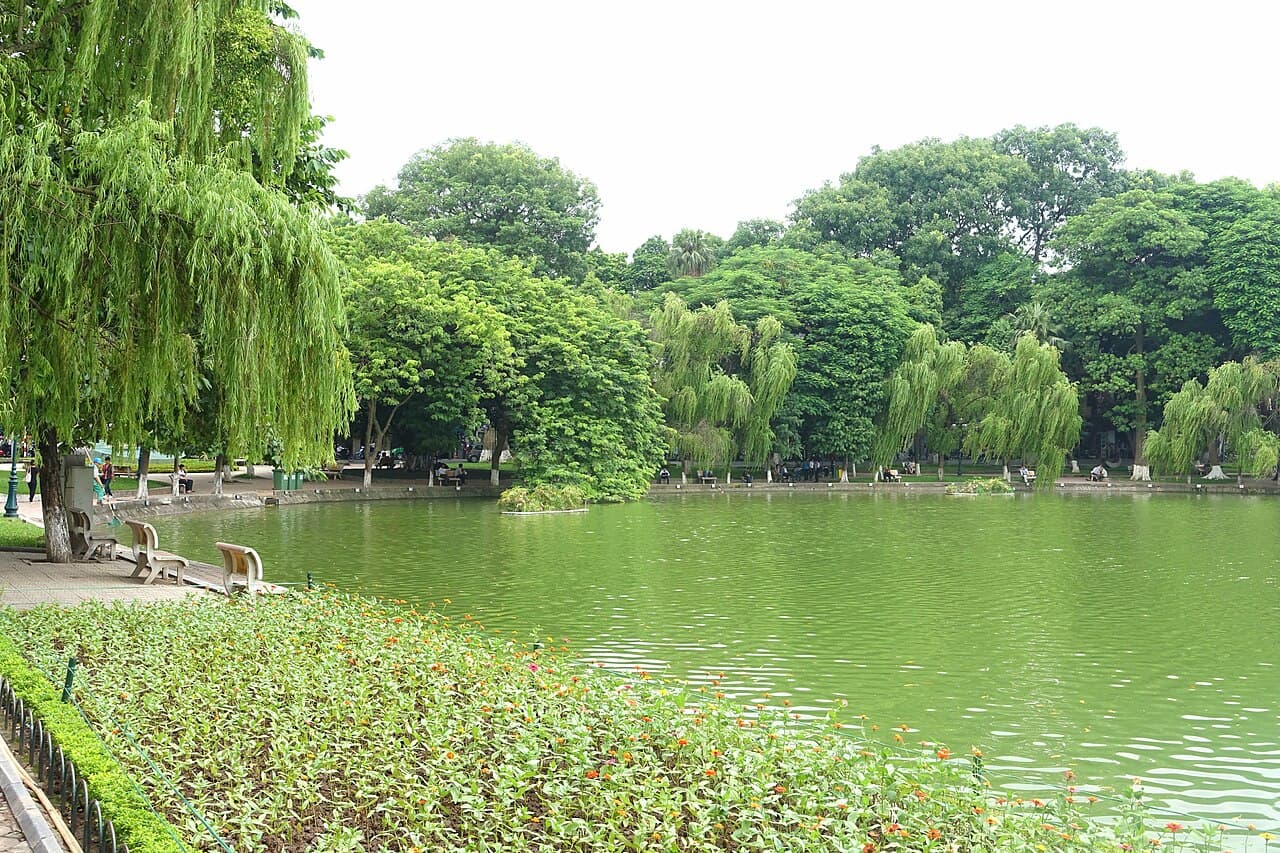
Around Hoan Kiem Lake and the Ngoc Son temple (on its island, reached by the red-lacquered The Huc Bridge), the city imposes its slowest rhythm: strollers, early morning fishermen, pavement badminton games, banh mi vendors. At weekends, the streets around the lake become pedestrian — a pocket of tranquillity in the heart of the city. Nearby, Saint Joseph's Cathedral (neo-Gothic, 1886) opens onto a square of lively cafés, one of the social hubs of the French quarter.
The Temple of Literature (Van Mieu, founded 1070) is one of the most beautiful and best-preserved monuments in Vietnam: five successive courtyards of pavilions, gardens, ponds and inscribed stelae bearing the names of doctors from the Confucian university — founded before the Sorbonne. Essential. Close by, the Ba Dinh district concentrates the monuments of the revolutionary era: Ba Dinh Square where Ho Chi Minh proclaimed independence in 1945, the Ho Chi Minh Mausoleum (queue, strict dress code, closed some days), the stilt house where he lived simply until his death, and the Vietnam Museum of Ethnology — one of the best museums in the region, with all 54 ethnicities represented and traditional houses reconstructed in the garden.
The train street, a residential alley in the Hoan Kiem district where the Hanoi-Ho Chi Minh City reunification train passes centimetres from the façades, has become one of the most photographed spots in the country. The atmosphere is genuine — residents have lived there for generations — and several cafés have installed themselves on upper floors to watch the trains pass. The One Pillar Pagoda (Chua Mot Cot, 1049) is another Hanoi symbol: a wooden temple perched on a single stone pillar in the middle of a lotus pond, the image printed on every 200,000 VND note.
For excursions, Ha Long Bay (3 hours by road, UNESCO-listed) is the absolute must: 1,969 limestone islands and islets emerging from emerald waters in a vertiginous karst panorama. Opt for a 2-day/1-night cruise on a traditional junk to fully experience the site. Ninh Binh (95 km south, 2 hours) offers the so-called "Ha Long Bay on land": karst formations amid rice paddies, the Bai Dinh pagoda complex, the Trang An grotto by rowing boat through the rocks.
Read also
- Northern Vietnam — the complete region — Hanoi, Ha Long Bay, Sapa, Ha Giang: itineraries and highlights of northern Vietnam.
- Ha Long Bay, the 1,969 karst islands — Cruising among the limestone rocks listed twice by UNESCO, 3 hours from Hanoi.
- Vietnam — complete country guide — Visas, budget, regions and best time to visit Vietnam.
- Hoi An, the lantern-lit ancient town — UNESCO merchant city 1 hour's flight from Hanoi, between canals, tailors and beaches.