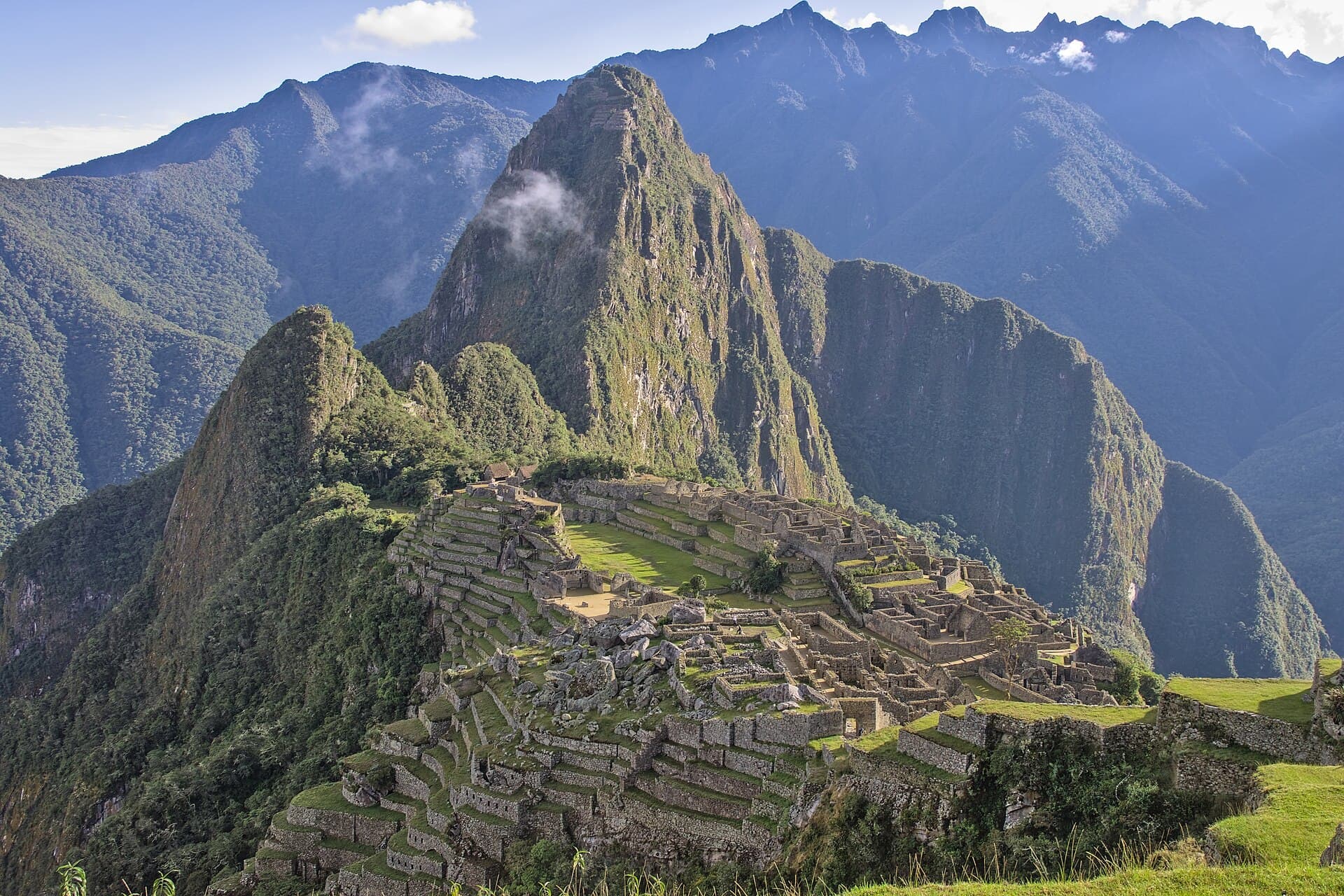
Cusco and Machu Picchu is Peru's major tourist region and one of the world's most powerful cultural destinations. Located in the country's south-eastern Andes, it spreads over 100 km around the former imperial capital a concentrate of Inca Empire heritage (1438-1533) without equivalent anywhere in the Americas. Cusco the historical capital (3,400 m, UNESCO 1983), Sacred Valley of the Incas (Ollantaytambo, Pisac, Maras-Moray), and especially the lost citadel of Machu Picchu (2,430 m, UNESCO 1983, named among the New 7 Wonders of the World in 2007) form the archaeological heart of the former Tahuantinsuyu.
The region organises around three complementary hubs with distinct personalities. Cusco (the base city, 450,000 inhabitants) is the former Inca capital that became baroque capital of the Viceroyalty of Peru (1533-1821). The historic centre layers cyclopean Inca walls (Coricancha sun temple, Sacsayhuamán cyclopean fortress, Hatunrumiyoc wall with its famous 12-angle stone) and Spanish colonial architecture (cathedral 1559-1654, Santo Domingo monastery built over the Coricancha, Plaza de Armas). It's the trip's logistical base and a fascinating site in its own right, deserving 2-3 nights.
The Sacred Valley of the Incas (Valle Sagrado, stretches 60 km along the Urubamba River between Pisac and Ollantaytambo, altitude 2,800-3,000 m) shelters major archaeological sites: Pisac (colorful Sunday market, spectacular agricultural terraces on the hill), Ollantaytambo (Inca fortress with its 17 terraces, still-inhabited Inca village with its original grid pattern, train departure point for Machu Picchu), Maras-Moray (millennial pink salt pans and circular agricultural amphitheatre, Inca agronomic laboratory), Chinchero (traditional Quechua textiles, dyeing demonstration). 2-3 nights in the valley allow gentler altitude acclimatization than Cusco.
Machu Picchu (2,430 m, 110 km from Cusco) is the experience's apex. Inca citadel built around 1450 by Emperor Pachacutec, probably a royal altitude residence and ceremonial center, abandoned around 1572 after the Spanish conquest (without ever being discovered by the Spanish, which explains its preservation). Rediscovered by American explorer Hiram Bingham in 1911, UNESCO-listed 1983, named among the New 7 Wonders of the World in 2007. Accessible only by train from Ollantaytambo + bus from Aguas Calientes, or by the mythical 4-day Inca Trail (limited to 500 trekkers/day, permits to book 6 months ahead).
Read also
- Machu Picchu — The 1450 Inca citadel, UNESCO 1983, named among the New 7 Wonders of the World.
- Cusco — The former Inca capital at 3,400 m, Plaza de Armas, Sacsayhuamán, UNESCO 1983.
- Peru — Complete country guide: visa, currency, regions, best time to visit.
- Arequipa and Titicaca — The other major Andean region — White City, Colca Canyon and sacred lake at 3,812 m.